Companies are generally permitted to buy property in Australia, although foreign-owned companies may require approval and face additional restrictions based on the type of property.
Whether a company is the right ownership structure depends on factors such as taxation, financing, liability protection, investment objectives, and whether the property is residential, commercial, or agricultural.
This article covers:
- Can foreign companies buy houses in Australia?
- What is the difference between a local company vs foreign company when buying property?
- Should you buy property under a company or individual?
- Can I buy land in Australia as a company?
- How much does it cost to buy land in Australia?
- Where is the cheapest place in Australia to buy land?
- How much is the tax when buying property and land in Australia?
- Which is better company or trust for buying property?
Key Takeaways:
- Australian and eligible foreign companies can buy property, subject to Australia's foreign investment rules.
- Foreign-owned companies may require FIRB approval and face residential property restrictions and state-based surcharges.
- Companies generally cannot claim the main residence exemption or the standard 50% CGT discount.
- Land purchases require due diligence on zoning, foreign investment rules, taxes, and development restrictions.
My contact details are hello@adamfayed.com and WhatsApp +44-7393-450-837 if you have any questions.
The information in this article is for general guidance only. It does not constitute financial, legal, or tax advice, and is not a recommendation or solicitation to invest. Some facts may have changed since the time of writing.
Can a local company buy property in Australia?
Yes, an Australian company can purchase property in Australia and hold the legal title in its corporate name. It can lease, develop, and sell the property, subject to local corporate and property laws.
Companies may acquire:
- Residential investment properties
- Offices and retail premises
- Warehouses and industrial sites
- Hotels and hospitality property
- Development land
- Agricultural land
- Mixed-use property
The directors should ensure that the purchase supports the company’s purpose and is properly authorized.
Can a foreign company buy property in Australia?
Yes, a foreign company can acquire certain property in Australia, but foreign investment approval and property-type restrictions may apply.
A foreign company may include an overseas-incorporated entity or an Australian company substantially owned or controlled by foreign investors.
Foreign investors are generally required to submit a foreign investment proposal before acquiring residential land, regardless of the property’s value.
They must also report relevant acquisitions and disposals to the Register of Foreign Ownership of Australian Assets.
As of July 2026, foreign investors are generally prohibited from purchasing established dwellings from April 1, 2025 to June 30, 2029, subject to limited exceptions.
The restriction applies to foreign-owned companies as well as foreign individuals.
Foreign companies are more commonly permitted to purchase:
- New residential dwellings
- Vacant residential land intended for development
- Residential development sites
- Commercial property
- Industrial property
- Hotels and tourism assets
- Agricultural land, subject to applicable thresholds and approval rules
A foreign investor purchasing vacant residential land should therefore confirm the development timetable before entering into an unconditional contract.
Australian company vs foreign company: Which is better for buying property?
An Australian company is generally better for buying property in Australia because it typically faces fewer regulatory hurdles, easier access to local financing, and simpler ongoing compliance than a foreign company.
A locally incorporated company has an Australian legal identity, an Australian Company Number (ACN), and a structure familiar to banks, conveyancers, tenants, and government authorities.
However, it may still be treated as a foreign person if it is substantially foreign-owned or controlled.
A foreign company can buy Australian property, but it may need to register with ASIC if it carries on business in Australia.
It may also face additional foreign investment approvals, corporate documentation requirements, and more extensive lender due diligence.
Should you buy property in Australia through a company or personally?
Buying via a company may be suitable for commercial activities and portfolio separation, while personal property ownership is often more tax-efficient for a home or small residential investment.
Individuals may qualify for the main-residence exemption, the 50% capital gains tax discount, and certain first-home concessions.
Advantages of buying through a company
A company can provide:
- Separation between business and personal assets
- Limited liability in certain circumstances
- Centralized management of multiple properties
- Easier admission of new shareholders
- Clear ownership percentages
- Continuity when directors or shareholders change
- Often better suited to property development or commercial operations
Disadvantages of buying through a company
Companies generally cannot claim the main-residence exemption because the company itself cannot occupy the property as its personal home.
Companies are also generally unable to use the standard 50% capital gains tax discount available to qualifying individuals and trusts.
Other disadvantages may include:
- ASIC registration and annual review costs
- Company tax returns and accounting expenses
- More complex financing
- Personal guarantees from directors
- State land tax may be higher depending on the jurisdiction and ownership structure
- Restrictions on private use
- Tax consequences when profits are distributed
- Limited access to individual homebuyer concessions
What are the requirements to buy a house in Australia as a company?
A company buying a house in Australia must be properly registered, have the necessary corporate authority, satisfy financing requirements, and obtain any required foreign investment approvals.
Registered company
An Australian company must be registered with ASIC and have an Australian Company Number (ACN).
A foreign company purchasing directly should determine whether it must register with ASIC before carrying on business in Australia.
Corporate authority
The purchase should be authorized by the company, with supporting documents such as a board resolution, ASIC company extract, company constitution, director identification, shareholder information, and evidence of signing authority where required.
Tax registration and company bank account
The company may require an Australian Business Number (ABN), a Tax File Number (TFN), and a company bank account to manage the purchase, taxation, rental income, and ongoing property expenses.
Finance approval
Where borrowing is required, the company must satisfy the lender's requirements, which may include financial statements, shareholder information, director guarantees, rental projections, and a property valuation.
Foreign investment approval
A foreign-owned company should confirm whether FIRB approval is required before signing an unconditional contract and ensure the contract includes an appropriate approval condition where necessary.
State compliance and due diligence
Before settlement, the company should confirm applicable transfer duty, foreign purchaser surcharges, land tax, and registration requirements, while also reviewing the property's title, encumbrances, zoning, planning restrictions, and approvals.
What is the process for buying a house in Australia through a company?
A company buys a house in Australia by selecting the purchasing entity, obtaining FIRB approval if required, completing due diligence and settlement, and registering the property in the company's name.
1. Select the purchasing company
Decide whether the buyer will be an existing Australian company, a newly incorporated company, or a foreign company.
The ownership structure should be finalized before signing the contract to avoid unnecessary tax and legal costs.
2. Confirm foreign investment requirements
Determine whether the company is considered a foreign person and whether FIRB approval is required before proceeding with the purchase.
3. Arrange finance and complete due diligence
Obtain finance approval if required, then assess the property's location, intended use, zoning, rental potential, and investment prospects.
Before the purchase becomes unconditional, a solicitor or conveyancer should review the title, contract, encumbrances, planning approvals, leases, and other legal matters.
4. Sign the contract and pay the deposit
The contract should identify the company using its registered name and ACN, and include conditions for finance, due diligence, and FIRB approval where applicable.
The deposit is typically paid into the seller's solicitor's or agent's trust account.
5. Complete settlement and registration
At settlement, the balance of the purchase price is paid, transfer documents are completed, and the property is registered in the company's name.
6. Meet ongoing compliance obligations
After settlement, the company should manage its tax, accounting, reporting, insurance, land tax, and property records.
How to avoid foreign property tax in Australia
A company can only reduce foreign property taxes in Australia through lawful structuring, available exemptions, and proper classification.
It cannot avoid them simply by incorporating in Australia.
Lawful planning may include:
- Confirm whether the company is foreign. Foreign ownership rules vary between federal and state laws, so the company's ownership and control should be reviewed before assuming a surcharge applies.
- Check available exemptions. Some states offer limited exemptions for eligible developers or qualifying foreign-owned businesses, subject to approval.
- Choose the ownership structure early. A genuinely Australian-owned company may avoid some surcharges, but nominee arrangements used to conceal foreign ownership can result in significant penalties.
- Select the right property type. Commercial property, new dwellings, and development land may be subject to different rules from established residential property.
- Compare state taxes. Foreign purchaser duty and land tax surcharges differ between states and territories, making the property's location an important tax consideration.
Can foreign companies own land in Australia?
Yes, foreign companies can own certain land in Australia, although approval requirements are based on the type of land and the applicable foreign investment rules.
- Residential land. Foreign companies may generally buy new dwellings or vacant residential land for development with the required approval, but are generally prohibited from purchasing established dwellings until 30 June 2029 unless an exception applies.
- Commercial land. Offices, warehouses, hotels, retail premises, and other commercial property can generally be purchased.
- Agricultural land. Foreign companies may acquire agricultural land, but notification or approval may be required once applicable monetary thresholds are exceeded.
How much to buy land in Australia?
Residential land in Australia had a reported national median price of approximately AUD391,420 in the September 2025 quarter, although prices range from under AUD100,000 in some regional areas to several million dollars in major cities and coastal markets.
Land prices vary according to factors such as:
- State or territory
- Location
- Lot size
- Zoning
- Infrastructure and utilities
- Development potential
- Environmental conditions
- Agricultural productivity
Agricultural land is typically priced per hectare rather than per lot, with values differing significantly based on location, water access, soil quality, and productivity.
When budgeting, companies should also account for costs beyond the purchase price, including:
- Transfer duty and FIRB fees
- Legal fees
- Land tax and GST
- Surveys and planning costs
Low-priced land is not always the best value, as sites with limited access, inadequate infrastructure, or development restrictions can result in substantially higher overall project costs.
Where is land cheapest in Australia?
Land is generally cheapest in remote and lower-demand areas of South Australia, Western Australia, inland Queensland, regional New South Wales, Tasmania, and north-western Victoria.
However, the cheapest state or town changes according to the type of land being measured.
Remote locations may offer larger parcels at lower prices, but they can also present:
- Limited demand
- Poor infrastructure
- Higher transport costs
- Environmental risks
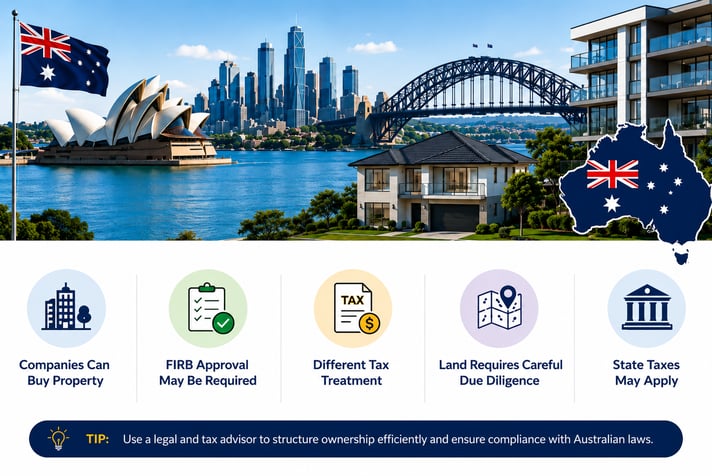 Taxes when buying property and land in Australia through a company
A company buying property or land in Australia may pay transfer duty, land tax, income tax, capital gains tax, GST, and additional foreign-owner surcharges where applicable.
Transfer duty
Transfer duty is charged by the state or territory and is generally based on the property’s purchase price or market value.
Foreign purchaser surcharge
Foreign-owned companies may pay an additional duty surcharge on residential property in some states, on top of standard transfer duty.
Land tax
Land tax is usually assessed annually on the taxable value of land, with rates, thresholds, exemptions, and foreign-owner surcharges varying by jurisdiction.
Company income tax
Net rental income is generally taxed at 25% for qualifying base-rate entities or 30% for other companies, although property investment companies may not qualify for the lower rate.
Capital gains tax
Companies generally pay tax on capital gains at the applicable company tax rate and cannot claim the standard 50% CGT discount available to qualifying individuals and trusts.
GST
GST may apply to new residential premises, commercial property, development land, and other taxable property transactions.
Foreign owner obligations
Foreign companies may also face withholding, reporting, and tax-clearance requirements when selling Australian property, as well as possible cross-border tax obligations.
Company vs Trust: Which is better for buying Australian property?
A trust in Australia is often better for long-term property investment, while a company is generally more suitable for business operations, commercial property, and property development.
Company
A company owns the property in its own name and may suit businesses and developers seeking a straightforward ownership structure, limited liability, and the ability to retain profits.
However, companies generally cannot claim the standard 50% capital gains tax discount available to qualifying individuals and trusts.
Trust
A trust holds property through a trustee for its beneficiaries and is commonly used for Australian investment property.
It may offer greater flexibility in distributing income, potential capital gains tax advantages, and succession planning benefits, although it is generally more complex to establish and administer.
Conclusion
Purchasing property and land in Australia through a company can be an effective strategy for commercial investments, property development, and larger portfolios, but it is not the best choice for every buyer.
The ownership structure you choose can significantly affect taxation, financing, regulatory obligations, and long-term returns.
Selecting the right structure before purchasing is often just as important as choosing the property itself.
Where appropriate, obtaining professional legal and tax advice can help avoid costly restructuring later.
FAQs
Can I buy a property in Australia as a non-resident?
Yes. Non-residents can generally buy new dwellings, development land, and eligible commercial property, but cannot generally buy established residential dwellings until 30 June 2029 unless an exception applies.
Can I get PR if I buy property in Australia?
No. Buying property in Australia does not provide permanent residency or a visa. You must qualify separately under Australia's immigration requirements.
What visas allow property purchases in Australia?
Temporary residents (such as Subclass 482, 491, or 500 visa holders) may generally buy new dwellings, vacant land for development, and certain eligible commercial property, subject to FIRB approval.
Permanent residents (including Subclass 189 and 190 visa holders) generally have the same property-buying rights as Australian citizens and do not normally require FIRB approval.
Can anyone buy land in Australia?
Yes, but not under the same rules. Australian citizens, permanent residents, and eligible Australian companies can generally buy land, while foreign persons and foreign-owned companies may need FIRB approval and must comply with restrictions based on the type of land.
Is housing still a good investment in Australia?
Australian housing can still be a good long-term investment, but returns vary by location, property type, and market conditions.
Related Articles:
- Can a company buy property or land in China?
- Can You Buy Property and Land in the Philippines through a Company?
- Can Foreigners Buy Property and Land in Indonesia Through a Company?
- Can Foreigners Buy Property and Land in Saudi Arabia Through a Company?
- LRS Limit for Buying Property Abroad from India: A Guide
- Buying Property in South Korea as a Foreigner: New Rules & Restrictions
- Thailand Property Crackdown Raises Risks for Foreign Investors