Companies can buy property and certain land rights in Indonesia, but the rules differ significantly for Indonesian companies and foreign-owned companies.
Choosing the appropriate ownership structure requires understanding Indonesia's land rights, corporate regulations, taxes, and investment objectives before completing a purchase.
This article covers:
- Can a corporation own a property in Indonesia?
- Can I buy land through my business in Indonesia?
- What is the land and building tax in Indonesia?
- Is it better to invest through a company?
- What are the land rights in Indonesia for companies buying land?
Key Takeaways:
- Foreign companies generally cannot own Indonesian freehold land but may acquire certain land-use rights through approved corporate structures.
- A PT PMA is a commonly preferred corporate structure for foreign investors undertaking commercial real estate projects in Indonesia.
- Buying through a company may offer advantages for commercial property, rental businesses, and larger investment portfolios.
- Careful legal and tax planning is essential before purchasing property or land in Indonesia.
My contact details are hello@adamfayed.com and WhatsApp +44-7393-450-837 if you have any questions.
The information in this article is for general guidance only. It does not constitute financial, legal, or tax advice, and is not a recommendation or solicitation to invest. Some facts may have changed since the time of writing.

Can a foreign company buy property in Indonesia?
Yes, foreign companies can buy property in Indonesia through a foreign investment company, subject to Indonesia's land ownership and foreign investment rules.
The most common structure for foreign investors is a PT PMA (Perseroan Terbatas Penanaman Modal Asing), which allows eligible foreign businesses to acquire and develop property for approved commercial activities.
A PT PMA is commonly used for investments in:
- Hotels
- Resorts
- Office buildings
- Warehouses
- Manufacturing facilities
- Commercial developments
- Certain residential and mixed-use projects where permitted
The specific ownership and land rights available to a PT PMA depend on Indonesian land laws, which distinguish between ownership of buildings and rights over the underlying land.
Foreign investors should also avoid informal nominee arrangements in which an Indonesian citizen holds property or land on behalf of a foreign buyer.
Such arrangements may not provide the intended legal protection and can expose investors to significant ownership disputes and enforcement risks.
Can a company own land in Indonesia?
Yes, companies can hold certain land rights in Indonesia, but the type of right determines how the land can be used, how long it can be be held, and whether it can be renewed or transferred.
The most common land rights available to companies include:
Hak Guna Bangunan (HGB)
HGB gives a company the right to construct, own, and use buildings on land for commercial purposes.
It is commonly used for offices, hotels, apartment developments, retail properties, factories, and other business assets.
Hak Guna Usaha (HGU)
HGU allows companies to use land for agriculture, plantations, fisheries, livestock, and other large-scale commercial agricultural activities.
Hak Pakai
Hak Pakai grants the right to use land for approved purposes and is commonly used for certain commercial projects and qualifying foreign investments.
Unlike these rights, Hak Milik (freehold ownership) is generally reserved for Indonesian citizens and is not typically available to foreign investment companies.
Before purchasing property through a company, investors should confirm that the available land right aligns with the property's intended commercial or investment use, as each carries different permitted uses, durations, renewal rules, and transfer requirements.
Can foreign companies own land in Bali?
No. Foreign companies cannot directly own freehold land in Bali, as the island follows the same land ownership laws that apply throughout Indonesia.
Although Bali is Indonesia's most popular destination for international real estate investment, it does not have separate laws allowing foreign companies to own freehold land.
Legal due diligence is particularly important because Bali's popularity has led to complex ownership structures, overlapping land claims, and widespread use of nominee arrangements that may expose foreign investors to significant legal uncertainty.
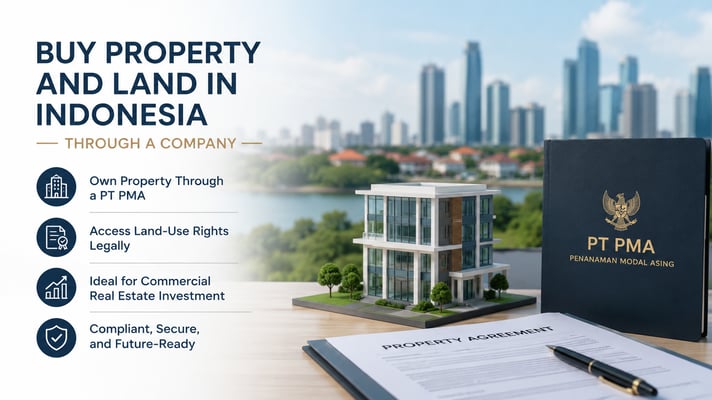
Should I Buy Property and Land in Indonesia Through a Company or Personally?
Buying property and land through a company is generally more suitable for commercial investments, property development, and larger real estate portfolios, while buying personally is often better for owner-occupied properties where legally permitted.
A corporate structure can make it easier to separate business assets from personal assets, admit new investors, obtain commercial financing, and manage multiple properties under a single entity.
It may also provide greater flexibility when expanding a real estate portfolio or planning future succession.
Buying personally may be appropriate for Indonesian citizens and eligible foreign individuals purchasing a home for personal use under the ownership rights available to them.
It generally involves fewer administrative and corporate compliance requirements than maintaining a company.
For foreign investors, personal ownership options are generally more limited than investing through a properly structured PT PMA for commercial projects.
The most appropriate ownership structure ultimately depends on the investor's residency status, investment objectives, intended property use, financing needs, and long-term exit strategy.
What is the property tax in Indonesia for companies?
Companies owning property in Indonesia are generally subject to annual property taxes, acquisition taxes, corporate income tax on rental profits, Value Added Tax (VAT) on certain transactions, and applicable regional taxes.
For example, companies buying land generally pay a Land and Building Acquisition Duty (BPHTB) of 5% of the taxable acquisition value, in addition to any applicable VAT and transaction costs.
Some taxes apply when the property is acquired, while others apply throughout the period of ownership and operation.
Understanding both the upfront acquisition taxes and the ongoing ownership taxes is essential when evaluating the total cost of a property investment.
The main taxes company buyers should consider include:
Annual Land and Building Tax (PBB)
Companies generally pay an annual Land and Building Tax (Pajak Bumi dan Bangunan or PBB) on qualifying land and buildings.
It is calculated using the government's assessed property value (Nilai Jual Objek Pajak or NJOP) together with the applicable local tax rates.
Land and Building Acquisition Duty (BPHTB)
Companies acquiring land or certain property rights generally pay Land and Building Acquisition Duty (Bea Perolehan Hak atas Tanah dan Bangunan or BPHTB).
Corporate Income Tax
Rental income and other taxable profits generated from Indonesian real estate are generally subject to Indonesian corporate income tax.
Companies should account for both ongoing operating income and any taxable gains arising from their property business.
Value Added Tax (VAT)
VAT may apply to certain purchases of new properties, commercial real estate transactions, and property-related goods or services, depending on the nature of the transaction and the seller's tax status.
Regional Property Taxes and Charges
Depending on the property's location and use, companies may also be subject to regional taxes, levies, or administrative charges imposed by local governments.
In addition to these taxes, company buyers should budget for notarial fees, deed preparation, land registration fees, and other administrative costs associated with acquiring and owning property in Indonesia.
What is the most tax-efficient way to buy property as a company?
For company buyers, the most tax-efficient way to purchase property in Indonesia is often through a PT PMA when the property will generate commercial income, such as rental apartments, hotels, resorts, offices, or industrial facilities.
Compared with holding the investment personally, a company can generally claim eligible business deductions and operate the property as an income-producing business.
However, these potential tax efficiencies are usually accompanied by higher administrative costs, corporate compliance obligations, accounting requirements, and ongoing reporting.
The most tax-efficient structure is one that supports the property's intended commercial use while remaining fully compliant with Indonesian tax and investment laws.
What is the best type of company for real estate investment in Indonesia?
For foreign investors, a PT PMA is generally the best company structure for commercial real estate investment in Indonesia, while a locally owned PT is typically more suitable for Indonesian investors.
PT PMA
A PT PMA is generally the preferred structure for foreign investors because it allows eligible foreign ownership while providing a recognized legal framework for acquiring property rights, operating commercial real estate businesses, hiring employees, obtaining business licenses, and expanding investments in Indonesia.
Local PT
A locally owned PT may provide broader ownership rights under Indonesian law and is commonly used by Indonesian investors purchasing commercial property or land.
Joint Venture Company
A joint venture between Indonesian and foreign investors may be appropriate where local participation, operational expertise, financing, or commercial objectives make a partnership beneficial.
Before selecting a company structure, investors should evaluate ownership restrictions, licensing requirements, taxation, financing, governance, and long-term business objectives.
Buying Existing Property vs Developing Property Through a Company
For company buyers, buying an existing property is generally better for generating immediate rental income, while property development offers greater potential returns but involves higher costs, longer timelines, and increased execution risk.
The better approach depends on the company's investment objectives, available capital, risk tolerance, and expected holding period.
| Consideration | Buying Existing Property | Property Development |
| Initial investment | Higher purchase price but immediate asset | Land acquisition plus phased construction costs |
| Rental income | Can begin soon after acquisition | Usually begins only after project completion |
| Development risk | Lower | Higher due to construction, permitting, and market risks |
| Capital appreciation | Depends on market performance | Potentially higher if the project is successfully completed |
| Financing | Often easier to obtain for completed assets | May require staged financing or higher equity contributions |
| Time to returns | Shorter | Longer |
| Management | Property management and maintenance | Development management, contractors, permits, and construction oversight |
| Best suited for | Companies seeking stable cash flow | Companies seeking long-term growth and value creation |
Conclusion
Property markets evolve, tax rules change, and foreign investment regulations are periodically updated.
An ownership structure should therefore be evaluated not only for today's rules but also for its ability to adapt to future legal, commercial, and investment changes without unnecessarily disrupting the underlying assets.
Investors who build flexibility into their ownership structure are often better positioned to respond to new opportunities, regulatory reforms, or changing business priorities.
In the long run, a structure that can adapt to change may prove just as valuable as the property itself.
FAQs
Is buying property in Indonesia a good investment?
Yes, Indonesia can offer attractive real estate investment opportunities, particularly in growing commercial centers and tourism destinations.
However, keep in mind that investment performance is also based on factors such as property type, legal ownership structure, market conditions, and the investor's long-term strategy.
Is it safe to buy property in Indonesia?
Yes, buying property in Indonesia can be safe when proper legal due diligence is carried out.
Investors should verify the land title, ownership rights, zoning, permits, and corporate compliance, and avoid informal nominee arrangements that may not provide legal ownership protection.
Can a foreigner own 100% of a business in Indonesia?
Yes, foreigners can own 100% of a business in Indonesia through a PT PMA in sectors that permit full foreign ownership.
However, full ownership of a business does not automatically grant freehold ownership of land.
Related Articles