Companies can generally buy residential property, commercial real estate, development land, and certain agricultural land in France, making corporate ownership a common option for investors and business owners.
While both French and foreign companies can generally acquire French real estate, the most suitable ownership structure depends on the property's intended use, tax considerations, financing needs, and long-term investment objectives.
This article covers:
- Can an LLC buy property in France?
- What is the tax on property purchase in France?
- Should you buy a property in France as a company or personal?
- What are the advantages and disadvantages of buying property in France through a company?
- Can a foreigner buy land in France?
- What are the steps to buy land in France through a company?
Key Takeaways:
- French and foreign companies can generally buy property and land in France.
- Corporate ownership may provide liability protection and succession planning benefits.
- Property held through a company is often subject to different tax rules than personal ownership.
- Land acquisitions require additional due diligence relating to zoning, planning, and agricultural restrictions.
My contact details are hello@adamfayed.com and WhatsApp +44-7393-450-837 if you have any questions.
The information in this article is for general guidance only. It does not constitute financial, legal, or tax advice, and is not a recommendation or solicitation to invest. Some facts may have changed since the time of writing.

What Types of Companies Can Own Property in France?
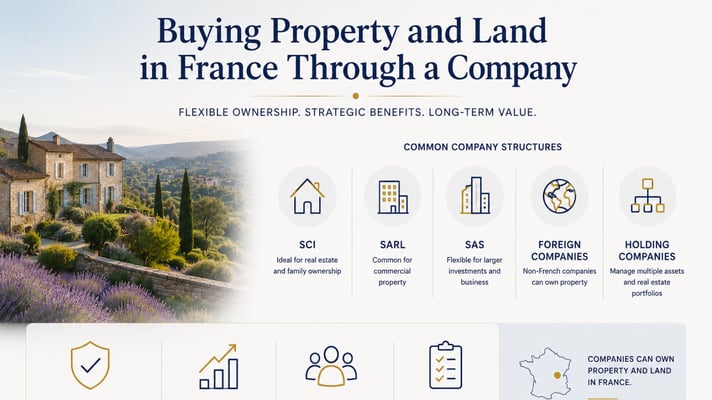
The main structures used to hold French property include SCIs, SARLs, SASs, holding companies, and certain foreign corporate entities.
The most appropriate structure depends on the investor's objectives, tax residency, financing strategy, and long-term ownership plans.
- Société Civile Immobilière (SCI): An SCI is one of the most widely used property-holding structures in France. It is commonly used by families and investors who want to own and manage property collectively.
- Société à Responsabilité Limitée (SARL): A SARL is a limited liability company often used for commercial activities and certain property investment operations.
- Société par Actions Simplifiée (SAS): An SAS offers greater flexibility in corporate governance and is commonly used for larger investment and business structures.
- Holding Companies: Holding companies are often used when French real estate forms part of a broader investment portfolio.
Can a Foreign Company Own Property in France?
Yes. A foreign company can generally own property in France, as the country does not usually restrict corporate ownership of residential, commercial, investment, or development property based solely on the nationality of the company or its shareholders.
Foreign investors may purchase French real estate through either a French-registered company with foreign ownership or an overseas company.
Foreign companies may acquire:
- Residential property
- Commercial property
- Office buildings
- Development land
- Industrial property
- Certain agricultural land, subject to additional regulations
A French-registered company, such as an SCI, SARL, or SAS, is often preferred by investors seeking a local operating presence, easier access to French banking and financing, and simpler management of rental or commercial activities.
An overseas company may be more appropriate where French property forms part of a broader international investment or holding structure.
Foreign companies must comply with applicable French legal, tax, anti-money laundering, and beneficial ownership requirements, regardless of whether the property is acquired through a French entity or directly by an overseas company.
Can an LLC Own Property in France?
Yes. A foreign LLC can generally own property in France, subject to French legal, tax, and reporting requirements.
France does not have a traditional LLC structure equivalent to those used in jurisdictions such as the United States.
However, foreign LLCs are generally recognized for property ownership purposes and may acquire residential, commercial, and investment real estate in France.
Before purchasing property through an LLC, investors should evaluate how the entity will be treated under both French tax law and the tax rules of its home jurisdiction.
The choice between using an LLC, an SCI, or another corporate structure can significantly affect taxation, succession planning, financing, and ongoing compliance obligations.
Can a Company Buy Land in France?
Yes. Companies can generally purchase land in France.
Companies commonly acquire land in France for development, commercial, industrial, agricultural, forestry, and long-term investment purposes.
However, agricultural land transactions may be subject to oversight by SAFER (Sociétés d'Aménagement Foncier et d'Établissement Rural), which has powers to review certain transactions involving rural and agricultural property.
Companies should also verify:
- Zoning classifications
- Development restrictions
- Building permits
- Environmental regulations
- Utility access
- Agricultural land rules
Can a Foreign Company Buy Land in France?
Yes. A foreign company can acquire land in France as it does not generally prohibit foreign corporate land ownership based on nationality alone.
The main restrictions usually relate to the type of land, permitted use, zoning, and regulatory review rather than foreign ownership itself.
Development land, commercial land, and industrial land should also be checked against local planning rules before purchase.
Foreign companies should verify zoning, access rights, environmental restrictions, utility availability, and whether the land can legally be used for its intended commercial, industrial, agricultural, or development purpose before completing the acquisition.
How to Buy Property as a Business in France?
Buying property through a company in France generally requires company registration, due diligence, notarial completion, and registration of the property in the company's name.
The process generally follows these steps:
-
Select the Corporate Structure. Choose the ownership vehicle that best fits the investment strategy. This may involve an SCI, SARL, SAS, foreign company, or another structure depending on the intended use of the property.
-
Establish or Register the Company. Incorporate a French entity or prepare the foreign company documentation required for acquisition. Investors should ensure the company is properly authorized to acquire and hold French real estate.
-
Arrange Financing. Secure funding through internal capital, lenders, or investors. Financing requirements may differ for companies compared to individual buyers.
-
Conduct Due Diligence. Review title records, zoning restrictions, permits, environmental considerations, and property conditions. Additional due diligence may be necessary for land acquisitions, particularly agricultural or development land.
-
Sign the Preliminary Agreement and Complete Reviews. Execute the initial purchase agreement, satisfy any conditions, and confirm compliance with French legal and tax requirements before completion.
-
Execute the Final Deed. Finalize the acquisition before a French notary. At this stage, the buyer typically pays the purchase price, applicable property transfer taxes, and acquisition costs such as notary fees and registration expenses.
-
Register Ownership. The ownership transfer is officially recorded, and the property is registered in the company's name. The company then becomes the legal owner of the French property or land.
How to Buy Land as a Business in France?
Companies generally buy land in France using the same legal purchase process as other real estate acquisitions, such as choosing a French or eligible overseas company. However, buying land requires additional due diligence to confirm what the land can legally be used for before completing the transaction.
In addition to the standard acquisition process, businesses should complete the following steps:
-
Confirm the land's legal status. Determine whether the land is agricultural, development, commercial, industrial, or protected land, as different regulations may apply.
-
Review planning permissions. Examine the local Plan Local d'Urbanisme (PLU) and, where appropriate, obtain a certificat d'urbanisme to confirm what can legally be built or operated on the land.
-
Obtain a Certificat d'Urbanisme. Where appropriate, obtain a certificat d'urbanisme confirming what development is legally permitted. Assess SAFER requirements. Agricultural land transactions may be reviewed by SAFER, which has pre-emption rights over certain rural land sales to protect agricultural use.
-
Review Environmental Constraints. Assess whether the land is affected by flood risks, contamination, protected habitats, archaeological restrictions, or other environmental regulations that could limit development or increase compliance obligations.
-
Verify Access and Utilities. Confirm that the land has appropriate road access, easements, and connections or availability for essential utilities, including electricity, water, sewerage, and telecommunications.
-
Confirm Development Feasibility. Ensure the proposed commercial, industrial, agricultural, or residential development is legally permitted and practically feasible before proceeding with the acquisition.
-
Carry Out Site Due Diligence. Confirm the land boundaries, easements, existing leases or occupancy rights, topography, and any physical characteristics that could affect the intended development or future use.
SCI vs Foreign Company for Property Ownership in France
An SCI is typically preferred for family ownership and succession planning in France, while a foreign company may be better suited to broader international investment structures.
These structures serve different purposes and are commonly used by different types of investors.
An SCI is specifically designed for property ownership and is often used for family holdings, succession planning, and long-term investment management.
It is one of the most common structures used for jointly owned French property.
Foreign companies may be appropriate when the property is held as part of a wider corporate, commercial, or international investment portfolio.
This approach is more common when the company already owns assets or conducts business across multiple jurisdictions.
The most suitable approach depends on:
- Ownership objectives
- Tax planning considerations
- Financing requirements
- Number of investors
- Long-term succession goals
Buying Property as a Company vs Individual in France
Companies are often used to buy French property for succession planning and shared ownership, particularly through structures such as an SCI, while individual ownership is generally simpler to manage and finance.
The most appropriate approach depends on the investor's objectives.
| Factor | Company Ownership | Individual Ownership |
| Liability | Separation between personal and business assets | Personal ownership exposure |
| Succession Planning | Often easier for multi-generational transfers | May require direct inheritance transfers |
| Administration | Higher compliance obligations | Simpler administration |
| Financing | Can be more complex | Often simpler for residential buyers |
| Tax Treatment | Corporate tax rules apply | Personal tax rules apply |
| Multiple Owners | Often easier to structure | Can become more complex |
Individual ownership is often suitable for primary residences and simple investment holdings.
Corporate ownership may be more attractive for investors managing multiple properties, family assets, commercial real estate, or development projects.
In France, SCI structures are particularly popular for jointly owned family property and long-term ownership planning.
What to Consider When Buying a Property in France?
When purchasing French property through a company, investors should evaluate the ownership structure, tax implications, financing options, compliance requirements, and long-term succession and exit plans.
Several factors can influence whether a corporate ownership structure is suitable for a particular investment.
Investment Objectives
The intended use of the property may influence the most suitable ownership structure.
A company used for a long-term rental portfolio may have different requirements than one acquiring commercial property, development land, or a family investment asset.
Corporate Structure
Different company structures can create significantly different legal and tax outcomes.
Investors should determine whether an SCI, SARL, SAS, foreign company, or another structure best aligns with their goals.
Financing Availability
French lenders may apply different underwriting standards to corporate borrowers.
Financing terms, loan-to-value ratios, and documentation requirements may differ from those available to individual buyers.
Ongoing Compliance
Corporate ownership typically involves accounting, reporting, and governance obligations.
These requirements can create additional administrative and professional costs over time.
Long-Term Planning
Investors should consider how the property may eventually be sold, transferred, or inherited.
Ownership structures can affect future asset transfers, tax treatment, and cross-border reporting obligations, particularly for international investors.
What Are the Taxes on Buying Property in France Through a Company?
Companies acquiring property in France may be subject to property transfer taxes, corporate income tax, capital gains tax, property taxes, and VAT in certain situations.
The specific taxes that apply depend on the ownership structure, property type, and intended use of the property.
Property Transfer Taxes
Property transfer taxes generally apply when purchasing existing real estate in France.
The applicable rate depends on the type of property and the nature of the transaction.
Corporate Income Tax
Rental income earned through a corporate structure may be subject to French corporate income tax.
Capital Gains Tax
Tax may apply when the property or company interests are sold.
The applicable treatment varies depending on the ownership structure and tax status of the company.
Local Property Taxes
Property owners may be responsible for recurring local taxes such as taxe foncière, depending on the property and ownership structure.
VAT
Certain commercial properties, newly developed properties, and specific real estate transactions may be subject to VAT rules.
In addition to taxes, companies purchasing property in France typically incur acquisition costs such as notary fees and registration expenses, which are separate from the taxes discussed above.
Because tax treatment varies significantly based on the ownership structure and property type, professional advice is often recommended before acquisition.
Is Buying Property in France Through a Company a Good Idea?
Buying French property through a company can be advantageous for family ownership arrangements, long-term property management, and ownership through structures such as an SCI.
It is particularly common when multiple family members own a property together or when investors want a more structured approach to transferring ownership across generations.
Situations where corporate ownership may be advantageous include:
Family Ownership and Shared Holdings
Structures such as an SCI are frequently used for family ownership, shared holdings, and long-term succession planning.
Company shares can often be transferred more easily than direct property interests, while France's forced-heirship rules make ownership structuring an important consideration for some investors.
Shared Ownership
Corporate structures can simplify ownership arrangements when multiple family members or investors jointly own a property.
Investment Property Portfolios
Multiple properties can often be managed more efficiently through a single structure.
Commercial Real Estate
Business and investment activities may align more naturally with corporate ownership.
Development Projects
Property development ventures are frequently conducted through corporate entities.
International Investments
Foreign investors may use companies to centralize ownership of French assets alongside holdings in other jurisdictions.
What Are the Disadvantages of Buying Property in France Through a Company?
The main disadvantages of buying property in France through a company are the added administration and compliance costs, particularly when the property is intended for personal or family use.
Administrative Requirements
Companies and SCIs generally require ongoing record-keeping, shareholder administration, and compliance with applicable filing obligations.
Tax Complexity
Corporate ownership can create more complex tax considerations than direct personal ownership, particularly for rental income, capital gains, and cross-border investors.
Financing Challenges
Corporate borrowers may face stricter lending criteria than individual buyers.
Limited Advantages for Personal Use Properties
For investors purchasing a single holiday home or personal residence, a company structure may introduce costs and complexity without providing significant additional benefits.
Additional Costs
Establishing and maintaining a French company or SCI typically involves legal, accounting, and administrative expenses.
These costs continue throughout the ownership period and can accumulate even when the property is not generating income.
Conclusion
Buying property and land in France through a company is a long-term ownership decision, not simply a transaction.
The ownership structure will influence future decisions involving financing, expansion, partner participation, and eventual asset transfers.
Investors who view the company as part of a long-term property strategy rather than merely a purchasing vehicle are often better positioned to manage their French real estate holdings over time.
FAQs
Can You Become a French Citizen by Buying Property in France?
No. Buying property in France does not provide a direct path to French residency or citizenship.
Foreign nationals may still qualify for residence permits through other immigration routes, but property ownership alone does not confer residency rights or lead to French citizenship.
Can I Buy a House in France as a Non-Resident?
Yes. Non-residents can generally buy houses and other real estate in France without becoming French residents or citizens.
Is it wise to buy property in France now?
Yes, buying property in France can be wise if the purchase fits your long-term goals, budget, and tax position.
Buyers should assess location, financing costs, ownership expenses, rental potential, and legal due diligence before deciding.
Related Articles