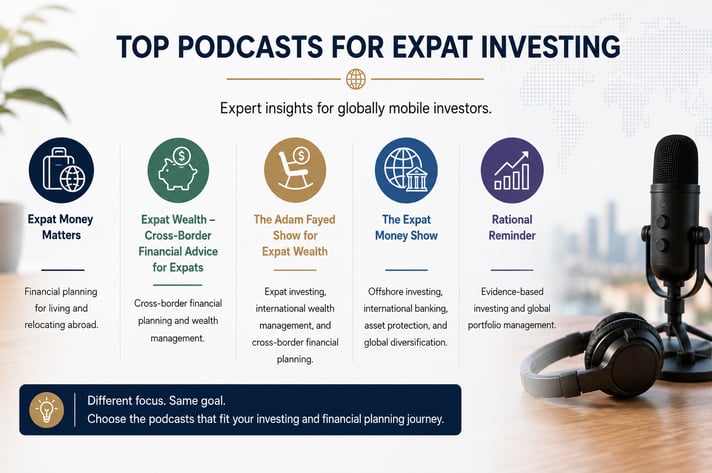
The best expatriate investing podcasts include Rational Reminder, Expat Wealth – Cross-Border Financial Advice for Expats, The Expat Money Show, Expat Money Matters, and The Adam Fayed Show for Expat Wealth.
Rather than recommending a single podcast, this guide compares each show's focus, strengths, and potential drawbacks to help expat investors choose the most suitable one for their investing goals and financial planning needs.
Some podcasts featured below are independently produced, while others are hosted by financial firms or advisors.
For transparency, this guide includes The Adam Fayed Show for Expat Wealth, hosted by Adam Fayed, who works with fully licensed partners and regulated advisors specializing in expatriate investing and international financial planning.
This article covers:
- What are the best podcasts for expat investing?
- What makes a great podcast for investing?
- Are investing podcasts helpful?
- What are the disadvantages of listening to podcasts?
Key Takeaways:
- The best podcasts combine investing insights with cross-border financial planning.
- Different podcasts specialize in different aspects of expatriate investing.
- Listening to multiple podcasts provides broader perspectives on global investing and international finance.
- Podcasts complement, but do not replace, personalized financial advice.
My contact details are hello@adamfayed.com and WhatsApp +44-7393-450-837 if you have any questions.
The information in this article is for general guidance only. It does not constitute financial, legal, or tax advice, and is not a recommendation or solicitation to invest. Some facts may have changed since the time of writing.

What is the best podcast to listen to for investing?
Some of the best podcasts for expatriate investing in 2026 include Expat Wealth – Cross-Border Financial Advice for Expats, Expat Money Matters, The Expat Money Show, The Adam Fayed Show for Expat Wealth, and Rational Reminder.
While several podcasts focus specifically on the financial needs of expats and globally mobile individuals, others offer broader investing insights, including evidence-based portfolio construction, long-term investing, and wealth management principles.
Many expatriates benefit from listening to more than one podcast.
For example, an investor may follow an expat-focused podcast for cross-border financial planning and international pension issues while also listening to a broader investing podcast covering portfolio construction, ETFs, and global markets.
Below are several podcasts that are particularly relevant for expatriates and internationally mobile investors.
|
Podcast |
Strengths |
Potential Drawbacks |
|
Covers relocation planning, weekly market updates, cross-border financial considerations, tax, residency, and practical money issues affecting British expatriates |
More focused on relocation and market commentary than dedicated investing or portfolio management |
|
|
Discusses investing, tax planning, retirement strategies, and wealth management for expatriates, particularly those with US connections |
Much of the content is geared toward US citizens living in America and abroad |
|
|
Covers expatriate investing, international wealth management, cross-border tax planning, international pensions, offshore structures, and long-term financial planning. |
More focused on international financial planning than day-to-day market commentary |
|
|
Explores offshore investing, international banking, second residency, asset protection, and global diversification |
Broader internationalization topics mean some episodes are less investment-focused |
|
|
Talks about ETFs, portfolio construction, behavioral finance, and global asset allocation supported by academic research |
Not specifically designed for expatriates or cross-border financial planning |
Which podcasts are best for wealth management, international pensions, and global investing?
Different podcasts excel in different areas of expatriate investing, from wealth management and international pensions to global investing.
- For expatriate wealth management: Expat Wealth – Cross-Border Financial Advice for Expats and The Adam Fayed Show for Expat Wealth are among the strongest choices for listeners interested in cross-border financial planning, wealth management, and investing while living abroad.
- For international pensions: There are few podcasts dedicated exclusively to international pensions. The Adam Fayed Show for Expat Wealth regularly discusses international pension planning within broader conversations on expatriate investing, while Expat Wealth – Cross-Border Financial Advice for Expats also addresses retirement planning for Americans living abroad.
- For global investing: Rational Reminder is one of the strongest choices for evidence-based investing, covering portfolio construction, exchange-traded funds (ETFs), behavioral finance, diversification, and global asset allocation.
- For offshore investing: The Expat Money Show is well suited to listeners interested in offshore investing, international banking, second residency, asset protection, and global diversification.
- For relocating abroad and financial planning: Expat Money Matters is particularly useful for understanding the financial implications of moving overseas, including residency, taxation, practical money matters, and regular market updates.
Many expatriates benefit from listening to more than one podcast.
Combining an expat-focused financial planning podcast with one centered on long-term investing can provide a broader perspective on managing wealth across different countries.
What makes a good podcast for expat investing?
A good expat investing podcast provides reliable insights into cross-border investing, expatriate wealth management, international financial planning, and global markets that are relevant to people living or working abroad.
Rather than focusing solely on stock picks or daily market news, the best podcasts help listeners understand the broader financial issues that can affect internationally mobile investors.
Coverage of cross-border financial issues
The strongest expat investing podcasts regularly discuss topics such as tax residency, offshore investing, international pensions, multi-currency investing, estate planning, and the financial implications of relocating between countries.
This helps expatriates understand how investment decisions may be affected by different legal and tax systems.
Practical investment insights
A quality podcast should offer educational discussions on portfolio construction, global asset allocation, diversification, risk management, and long-term investment strategies for expats.
Practical insights are generally more valuable than short-term market predictions.
Credible hosts and expert guests
Look for podcasts hosted by experienced investors, financial professionals, or subject-matter experts who regularly interview economists, fund managers, tax specialists, and other industry professionals.
A variety of informed perspectives can help listeners develop a more balanced understanding of investing.
Consistent and up-to-date content
Financial markets and regulations change over time, making regular publication important.
Podcasts that consistently release new episodes are more likely to discuss current market conditions, regulatory developments, and emerging trends relevant to expatriate investors.
Educational rather than promotional approach
The best podcasts aim to educate listeners by explaining investment concepts, discussing different viewpoints, and encouraging informed decision-making.
While some podcasts are produced by financial firms or advisors, their educational value should extend beyond promoting specific products or services.
How should expats choose an investing podcast?
Rather than searching for a single "best" podcast, focus on finding one that matches your financial priorities, investing style, and life abroad.
Many expatriates benefit from listening to different podcasts for various perspectives.
Consider choosing podcasts based on your priorities:
- If you're new to investing, start with podcasts that explain portfolio construction, investing fundamentals, and long-term wealth building.
- If you live abroad, prioritize shows covering expatriate investing, cross-border financial planning, international taxation, and global wealth management.
- If you're approaching retirement, look for podcasts discussing pension planning, retirement income, and long-term financial security.
- If you already have investment experience, broader market commentary and evidence-based investing podcasts can help supplement specialist expat content.
Combining both specialist expatriate podcasts and broader investing podcasts often provides a more balanced understanding of international wealth management and long-term investing.
Are there any benefits to listening to podcasts?
Yes. Investing podcasts can help expatriates stay informed while learning from experienced investors, economists, and financial professionals.
Some of the main benefits include:
- Convenient learning while commuting or travelling
- Exposure to multiple investment perspectives
- Better understanding of global markets
- Insights into international pensions and cross-border finance
- Regular updates on economic and investment trends
Many podcasts also feature interviews with portfolio managers, academics, and financial planners who share practical investing insights.
What are the disadvantages of podcasts?
The main disadvantages of investing podcasts are that they provide general educational content, may become outdated, and cannot offer personalized financial advice for your individual circumstances.
While podcasts can be an excellent way to learn about investing, listeners should understand their limitations before making financial decisions based solely on what they hear.
Some disadvantages include:
- Episodes may become outdated as markets, regulations, and tax laws change.
- Hosts often share personal opinions or investment philosophies rather than universally accepted strategies.
- Some discussions are specific to a particular country and may not apply to expatriates elsewhere.
- Podcasts cannot account for an individual's financial goals, risk tolerance, tax residency, or overall financial circumstances.
Should you rely on podcasts alone for expat financial planning?
No. Podcasts can improve financial knowledge, but they cannot replace personalized expat financial planning.
International investing often involves complex issues such as:
- Tax residency
- International pension transfers
- Estate planning
- Currency management
- Regulatory compliance
- Cross-border taxation
These topics frequently require advice tailored to an individual's country of residence, citizenship, assets, and long-term objectives.
For many expatriates, podcasts are most valuable as an educational tool alongside professional advice where appropriate.
Conclusion
The most valuable expat investing podcasts combine practical cross-border financial guidance with sound long-term investing principles.
For internationally mobile investors, understanding topics such as tax residency, international pensions, and global asset allocation can be just as important as following market trends.
Listening to a mix of expat-focused and broader investing podcasts offers a more balanced perspective on building and managing wealth across different countries.
FAQs
Which podcasts are useful for expat entrepreneurs?
The Adam Fayed Show for Expat Wealth is one option because it covers entrepreneurship, business ownership, cross-border tax planning, offshore structures, and expatriate finance.
Depending on your interests, broader investing podcasts or specialist expat finance podcasts may also provide valuable perspectives.
Will financial advisors be obsolete?
No. Technology, artificial intelligence, and investing podcasts have made financial information more accessible, but they do not replace personalized advice.
This is particularly true for expatriates, whose financial planning may involve international taxation, pensions, residency, and estate planning across multiple jurisdictions.
Where should a beginner start investing?
Beginners should start by paying off high-interest debt, building an emergency fund, and investing in a diversified portfolio such as low-cost index funds or exchange-traded funds (ETFs) based on their financial goals and risk tolerance.
Expatriates should also consider tax residency, international pension arrangements, and currency exposure before investing abroad.
What does Warren Buffett recommend for investing?
Warren Buffett has consistently recommended that most long-term investors use low-cost index funds rather than trying to outperform the market through frequent trading or stock picking.
He has also emphasized maintaining a long-term investment horizon and avoiding emotional investment decisions during market volatility.
What is the 3 5 7 rule of investing?
There is no universally accepted 3-5-7 rule of investing.
In trading, however, the 3-5-7 rule commonly refers to a risk management guideline of risking no more than 3% on a single trade, limiting total market exposure to 5%, and targeting around a 7% profit on successful trades.
Related Articles: