Life insurance can help cover a UK inheritance tax (IHT) bill by providing beneficiaries with a lump sum when the policyholder dies.
Writing the policy in trust can also help keep the proceeds outside the deceased’s taxable estate, provided the arrangement is structured correctly.
The effectiveness of this strategy is based on the type of policy, the amount of cover, the trust structure and the tax rules applying when the insured person dies.
Key Takeaways
- UK inheritance tax is generally charged at 40% above applicable thresholds, making accurate liability estimates essential when calculating cover.
- Whole-of-life insurance suits lifelong IHT exposure, while term insurance can cover temporary risks, such as certain lifetime gifts.
- Transferring an existing policy into trust can have different tax implications from placing a new policy in trust.
- Trust terms determine who controls the policy and how proceeds are distributed, affecting whether the payout stays outside the estate.
My contact details are hello@adamfayed.com and WhatsApp +44-7393-450-837 if you have any questions.
The information in this article is for general guidance only. It does not constitute financial, legal, or tax advice, and is not a recommendation or solicitation to invest. Some facts may have changed since the time of writing.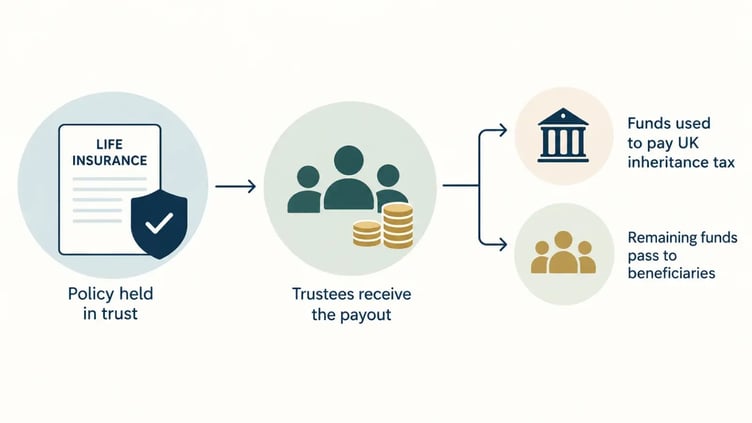
How life insurance can cover a UK inheritance tax bill
Life insurance can cover a UK inheritance tax bill by providing a lump sum on death to help beneficiaries pay the tax without selling inherited property or investments.
UK inheritance tax is generally charged at 40% on the taxable portion of an estate above the available thresholds.
The standard nil-rate band is £325,000, while an additional residence nil-rate band of up to £175,000 may be available when a qualifying home is passed to direct descendants.
The residence nil-rate band is subject to eligibility requirements and tapers for estates worth more than £2 million.
Unused allowances may also be transferable between spouses or civil partners, potentially increasing the combined nil-rate band to £650,000 and the combined residence nil-rate band to £350,000 where the relevant conditions are met.
However, an estate can face an inheritance tax bill even when most of its wealth is held in property, business interests or investments rather than cash.
For example, an individual may own a UK property worth £900,000 alongside a relatively small cash balance.
If the estate is taxable, the executor may need to arrange payment of IHT before the beneficiaries can receive their inheritance in full.
Selling property or investments to raise the necessary funds may take time and could disrupt the family's plans.
Life insurance can help address this liquidity problem.
The policy pays a lump sum when the insured person dies, which can be used to meet the tax liability or provide beneficiaries with the funds needed to contribute towards it.
If the proceeds are payable to the deceased's estate, they may themselves increase the value subject to IHT.
How to keep life insurance proceeds out of estate
The principal way to keep life insurance proceeds outside the policyholder's estate is to arrange for the policy to be held in an appropriate trust, with the trustees receiving and distributing the proceeds under its terms.
When an individual owns a policy personally, the death benefit may form part of their estate for IHT purposes.
If the policy is written in trust from the outset, the trustees generally hold the policy for the trust's beneficiaries, rather than the policyholder retaining personal ownership of it.
This distinction can affect both the tax treatment of the proceeds and how quickly beneficiaries receive the money.
For instance, consider an individual with a potentially taxable estate who takes out a whole-of-life policy specifically to provide funds for an inheritance tax bill.
If the policy is payable to the estate, the proceeds may add to the estate's taxable value.
If the policy is appropriately written in trust, the proceeds may be paid directly to the trustees and distributed in accordance with the trust deed, without becoming part of the deceased's free estate.
The trust can help separate the source of funds used to pay the tax from the assets that give rise to the liability.
However, placing a policy in trust does not automatically make every arrangement exempt from IHT.
The legal ownership, trust terms, beneficial interests and any transfers involved must be considered.
Transferring an existing policy into trust may also have different tax implications from establishing a new policy in trust at inception.
A trust can also help beneficiaries access the proceeds without waiting for the ordinary probate process to be completed.
An Inheritance to Leave. A Tax Bill to Fund.
Your family may inherit valuable property and investments without enough cash to meet the tax bill. Discuss how life insurance held in an appropriate trust could help fund that bill and reduce the need to sell inherited assets.
Discuss Your OptionsWhich type of life insurance is best for inheritance tax planning?
Whole-of-life insurance is generally best for covering a UK inheritance tax liability that could arise at any time, while term life insurance is more suitable for temporary exposure, such as potential tax on lifetime gifts.
Whole-of-life insurance
Whole-of-life insurance provides cover for the insured's lifetime, making it suitable for estates expected to remain above the relevant IHT thresholds.
The policy pays out on death, provided it remains in force and its conditions are met.
Premiums are typically higher than those for term insurance, and some policies allow premiums to change over time.
The level of cover should reflect the estimated tax liability and be reviewed as asset values and estate circumstances change.
Term life insurance
Term insurance provides cover for a fixed period, making it useful when an IHT exposure is expected to diminish over time.
For example, a potentially taxable lifetime gift may become exempt from IHT if the donor survives seven years after making it, subject to the applicable rules.
Gift inter vivos insurance can provide funds if the donor dies within that period, with decreasing cover potentially reflecting the declining tax exposure.
However, term insurance does not provide a guaranteed payout if death occurs after the policy expires, making it less suitable for funding an IHT liability that could arise at any point in life.
How to put life insurance in trust for inheritance tax planning
To put life insurance in trust for UK inheritance tax planning, choose a suitable trust, appoint trustees, and complete the necessary trust documentation so the policy proceeds can be paid and distributed according to the trust's terms.
1. Calculate the inheritance tax bill the policy needs to cover
Estimate the estate's potential IHT liability by accounting for property, investments, cash, relevant lifetime gifts, debts, available allowances and applicable reliefs.
This establishes how much insurance may be needed to help beneficiaries pay the bill without selling inherited assets.
2. Choose life insurance that matches the tax exposure
Whole-of-life insurance may suit an IHT liability that could arise at any point, while term insurance may be appropriate for temporary exposure, such as certain lifetime gifts.
Consider whether the payout will be sufficient to meet the expected tax bill and whether the premiums are sustainable over the required period.
3. Choose a suitable trust structure
Select a trust that reflects who should benefit from the payout and how the proceeds should be distributed.
The structure must be appropriate for the intended IHT treatment, as the trust's terms and the policy's ownership can affect whether the proceeds fall outside the deceased's estate.
4. Place the policy in trust correctly
A new policy can often be written in trust when it is established, using the insurer's documentation or professional legal advice.
An existing policy may also be transferable, but the transaction should be reviewed carefully because it can have tax implications. Correct documentation is essential to ensure the intended arrangement is legally effective.
5. Review the cover and trust as circumstances change
Property values, investments, family circumstances and tax rules can change the amount of IHT due.
Review the policy to ensure the payout remains adequate and confirm that the trust arrangements still reflect the intended beneficiaries and estate planning objectives.
Professional advice can help identify changes that might affect the policy's tax treatment.
Conclusion
A life insurance policy intended to cover UK inheritance tax should be assessed against the outcome it is meant to protect.
For a family hoping to pass down a property, that may mean ensuring the tax bill can be settled without requiring beneficiaries to sell the home or take on debt to retain it.
This also explains why the trust arrangement deserves as much attention as the amount insured.
The policy needs to deliver funds to the right people, under the right legal structure, at the point the tax becomes payable.
Without that alignment, a substantial payout may still fail to protect the inheritance as intended.
FAQs
Does a spouse pay inheritance tax on life insurance?
A spouse or civil partner does not automatically pay IHT on life insurance proceeds, but the payout may be subject to IHT if it forms part of the deceased's taxable estate.
Transfers between spouses are generally exempt, subject to applicable conditions and exceptions.
Can I put my life insurance policy in a trust and borrow against it?
You can place a life insurance policy in trust, but borrowing against it varies based on whether the policy has a cash value and whether its terms and trust arrangements permit borrowing.
If the policy is held in trust, the trustees may control these decisions rather than the original policyholder.
What is the new inheritance tax law in the UK?
From 6 April 2027, most unused pension funds and pension death benefits are due to be included in the deceased's estate for IHT purposes, subject to applicable exceptions.
The main IHT thresholds are also frozen through the 2030–31 tax year.
Is life insurance payout subject to inheritance tax in the UK?
Yes, a life insurance payout may be subject to IHT if it forms part of the deceased's estate.
Writing the policy in a properly structured trust can help keep the proceeds outside the estate, although the outcome is based on the policy ownership, trust terms and applicable tax rules.
Related Articles
- Death Tax: The Wealth Planning Issue Most Families Avoid Until It’s Too Late
- How do the rich avoid inheritance tax?
- How The Wealthy Use Life Insurance to Preserve Wealth
- Which Firms Help Expats Plan Inheritance?
- What Is a Protector in a Trust and Why It Matters for Expats
- Pensions Coming Into UK Inheritance Tax From April 2027: What Expats Should Do
- 7 Mistakes UK Leavers Make With Pensions