Mauritius Structured Investment-Linked Insurance Business (SILIB) allows HNWIs and financially sophisticated investors to hold a dedicated investment portfolio within a regulated long-term life insurance structure.
Introduced under Mauritius' SILIB framework in 2022, it can accommodate a broad range of investments while combining investment management with insurance and succession planning functions.
Its suitability for international investors depends heavily on costs, policy structure and the tax rules where the policyholder lives.
Key Takeaways
- Mauritius SILIB has a regulatory minimum premium of USD 250,000 or equivalent.
- SILIB allows HNWIs to hold a broad, customized portfolio within a life insurance structure.
- Dedicated portfolios and regulated custody provide structural safeguards, but investment risks remain.
- For expats, tax residence can matter as much as the Mauritius structure itself.
My contact details are hello@adamfayed.com and WhatsApp +44-7393-450-837 if you have any questions.
We offer bespoke structuring solutions tailored to your situation and have business interests in Mauritius, including relationships with locally licensed advisors.
The information in this article is for general guidance only, does not constitute financial, legal, or tax advice, and may have changed since the time of writing.
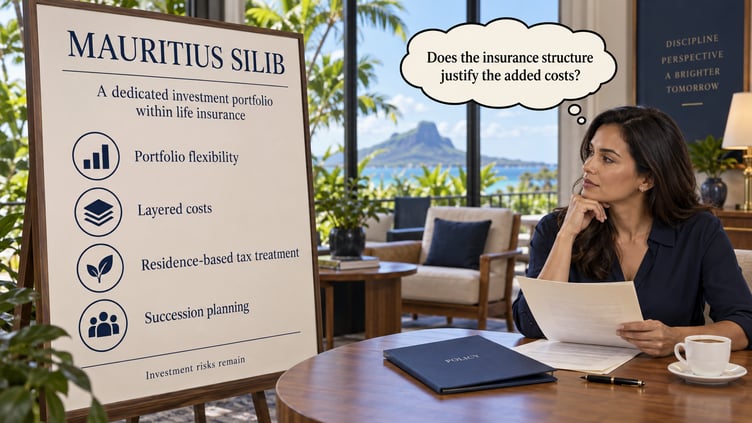
What is Mauritius Structured Investment-Linked Insurance Business?
Mauritius SILIB is a regulated form of long-term insurance under which policy benefits are linked wholly or partly to the value or income of a dedicated investment portfolio.
The concept is sometimes described more simply as an insurance wrapper.
In fact, the FSC originally developed the framework under the term Insurance Wrappers before adopting Structured Investment-Linked Insurance Business as the formal terminology.
The underlying portfolio remains central to the economic outcome. If its investments increase or decrease in value, that affects the value and benefits of the policy.
What changes is the legal structure through which the investments are held.
Each policy has a dedicated portfolio rather than participating in a common investment pool. The FSC specifically distinguishes SILIB from ordinary linked long-term insurance on this basis.
How does a Mauritius SILIB policy work?
A SILIB policy brings together the policyholder, insurer, custodian and investment manager within a regulated insurance arrangement.
The insurer issues the life insurance policy. Assets supporting the policy are placed with an approved custodian, while investment management may be performed internally by the insurer or outsourced to an appropriately licensed asset manager.
The policyholder can agree an investment policy statement and investment strategy with the insurer or asset manager.
This gives SILIB considerably more portfolio customization than a conventional retail investment-linked policy.
The FSC also requires life insurance coverage to form part of SILIB. Benefits on death or termination are wholly or partly determined by reference to the dedicated portfolio's value.
Who can use SILIB in Mauritius?
Mauritius SILIB is specifically targeted at HNWIs and financially sophisticated clients with existing investment portfolios. This intended market is stated directly by the FSC.
That makes SILIB potentially relevant to expatriates and international investors with substantial portfolios across multiple investments or jurisdictions.
It may suit those considering whether an insurance-based ownership structure fits their wider wealth planning.
The USD 250,000 regulatory minimum also places it outside the normal retail investment market.
Can expats and non-Mauritius residents use SILIB?
The SILIB framework is designed with international wealth management in mind, but an expat's ability to use a particular policy varies based on the insurer and the laws of the investor's country of residence.
A Mauritius-regulated insurance structure does not override insurance, securities or tax rules elsewhere.
The FSC recognizes this directly by stating that SILIB operates according to the legal and tax regimes applicable in the policyholder's country of residence.
An expat needs to consider both sides of the structure, i.e., whether the Mauritius insurer can accept them and how their country of tax residence treats the policy.
What can a Mauritius SILIB policy invest in?
A Mauritius SILIB can hold cash, funds, shares, bonds, derivatives, property, and listed and unlisted investments.
There is no geographical restriction on assets held within a SILIB policy.
That potentially allows one policy to accommodate assets across multiple markets and asset classes rather than requiring the policyholder to choose from a short menu of insurer-selected funds.
Existing assets may also form part of the dedicated portfolio at inception, rather than the structure necessarily starting with an entirely new portfolio.
There are nevertheless regulatory controls. Among them, the insurer:
- cannot invest SILIB assets in securities of a related company of the insurer or asset manager,
- cannot lend SILIB money to those related companies,
- must conduct transactions at arm's length and consistently with the policy's investment objectives.
What is the minimum investment for Mauritius SILIB?
The regulatory minimum single premium for a Structured Investment-Linked Insurance Business in Mauritius is USD 250,000 or the equivalent in another currency.
For a regular premium arrangement, expected premiums over the full contract term must total at least USD 250,000 or equivalent, measured at inception.
This is a regulatory floor. Individual insurers can establish product terms that result in higher practical entry requirements.
What fees and costs does a Mauritius SILIB policy have?
There is no single universal SILIB fee schedule because charges vary based on the insurer, policy, investment manager, custodian and underlying assets.
The SILIB Rules instead impose disclosure requirements. Policy documentation must disclose the applicable charges, while policyholder statements must report expenses, fees and commissions incurred.
Potential costs can arise at several levels, including the insurance contract, custody, investment management and the underlying investments.
Performance fees can also apply where provided by the product. If they do, the product summary must disclose who receives the fee and its maximum amount or percentage of net assets.
Performance-fee crystallization cannot occur more frequently than annually.
Investors should consequently compare the total cost of the structure, rather than treating one quoted policy charge as the complete cost.
How are Mauritius SILIB assets held and protected?
Each SILIB policy must have a segregated portfolio held separately for the individual policyholder with an FSC-approved custodian.
Custodians take the assets into custody for safekeeping and act on instructions from the asset manager or insurer. Custodians and sub-custodians must operate independently from the asset manager and insurer.
The rules also establish liability where a custodian causes loss through unreasonable failure or improper performance of its obligations.
In addition, the insurer must keep at least 5% of the assets under each policy or USD 20,000, whichever is lower, in cash or cash equivalents.
Segregation should not be interpreted as a guarantee against investment losses. The underlying portfolio remains exposed to the risks of the assets it holds.
How is SILIB taxed in Mauritius?
Mauritius does not provide one universal SILIB tax outcome for international policyholders.
The FSC states that taxation of policy proceeds depends on the laws applicable to the policyholder according to their tax residence.
When introducing SILIB, the FSC did not create a separate Mauritius tax regime specifically for the product.
Its consultation work stated that the existing tax treatment applicable to long-term insurance policies would apply to SILIB.
For an internationally mobile investor, this makes residence especially important.
A country may have its own rules concerning life insurance wrappers, withdrawals, gains, death benefits, reporting and the tax treatment of underlying investments.
Moving between countries can also alter the treatment of an existing policy.
SILIB should not be described generically as tax-free or tax-efficient. Those conclusions require analysis of the policyholder's actual tax residence and circumstances.
Is Mauritius SILIB the same as a trust?
No. A SILIB policy is an insurance contract linked to a dedicated investment portfolio, while a trust is a legal arrangement in which a trustee holds and administers assets under the terms of the trust.
The structures can address overlapping wealth planning concerns, particularly succession, but they achieve them differently.
|
Question |
Mauritius SILIB |
Trust |
|
Core structure |
Long-term insurance policy |
Trust relationship |
|
Investments |
Dedicated portfolio linked to policy |
Assets held within trust |
|
Key regulated/appointed parties |
Insurer, custodian, asset manager |
Trustee and other appointed advisers |
|
Life coverage |
Part of SILIB |
Not inherent |
|
Beneficiary planning |
Through insurance arrangements |
Through trust terms |
|
Investment management |
Within SILIB investment framework |
Determined by trust structure and mandate |
|
Tax outcome |
Depends on residence and circumstances |
Depends on trust type, parties and jurisdictions |
The FSC specifically identifies succession planning as one of SILIB's intended uses.
That does not make SILIB a substitute for every function a trust can perform.
Trusts can address governance, control and multigenerational ownership arrangements that extend beyond what an insurance contract is designed to achieve.
How is Mauritius SILIB different from an investment account?
The main difference is that SILIB places the investment portfolio inside a long-term insurance structure, whereas an ordinary investment account gives the investor direct account-based exposure to the investments.
With a conventional brokerage or investment account, the investor normally holds securities through the account and receives the resulting investment income and gains according to that structure.
Under SILIB, policy benefits are linked to the value or income of the dedicated portfolio, and the assets are held with an approved custodian within the insurance arrangement.
That distinction can affect succession, ownership, administration and taxation. It also adds additional parties and contractual layers.
Investors need a sufficiently strong wealth planning reason for using an insurance wrapper instead of simply holding an investment portfolio directly.
What are the advantages and disadvantages of Mauritius SILIB?
SILIB's main advantages are investment flexibility and wealth planning functionality, while its main disadvantages are complexity, costs and dependence on cross-border tax and legal treatment.
Advantages
- A dedicated investment portfolio for each policyholder
- Broad permitted investments, including listed and unlisted assets
- No FSC geographical restriction on portfolio assets
- Existing investments can potentially form part of the portfolio
- Regulated custody and asset segregation
- Integration of investment management, life insurance and succession planning
- Investment strategies can be tailored to individual policyholders
Disadvantages
- USD 250,000 regulatory minimum limits accessibility
- Multiple layers can create higher costs than direct investing
- International tax treatment is residence-dependent
- Relocation can create tax complications
- Higher structural complexity
- Less direct control over investments
Conclusion
The significance of Mauritius Structured Investment-Linked Insurance Business lies in the ability to build an individually managed investment portfolio inside a regulated insurance framework rather than forcing sophisticated investors into a standardized investment-linked product.
That flexibility also changes how SILIB should be evaluated. The investment portfolio is only one component.
Custody, policy terms, costs, beneficiaries, tax residence and the legal treatment of the insurance contract can ultimately matter as much as investment selection.
For expats and internationally mobile HNWIs, the long-term suitability of SILIB can depend on where they live now and where they may relocate later.
A structure established in Mauritius may interact differently with the tax, succession and insurance rules of each country in which the policyholder becomes resident.
The strongest case for SILIB is consequently where the insurance structure serves a clear purpose beyond investment access, such as coordinating a substantial portfolio with succession or cross-border wealth planning.
Investors should assess that purpose first, then determine whether the additional costs and complexity of the wrapper are justified by the benefits it provides.
FAQs
Can existing investments be transferred into a Mauritius SILIB policy?
Yes, the Mauritius framework permits a SILIB portfolio to include the policyholder's existing assets and investments at inception.
Whether a particular asset can practically be transferred will also depend on the insurer, custodian and applicable laws.
Can a SILIB in Mauritius hold property?
Yes. The FSC expressly includes property among the types of assets that may be held in a SILIB portfolio.
Who can advise on a Mauritius SILIB policy?
SILIB advice is restricted to qualified intermediaries. In Mauritius, this means a person holding both an Insurance Broker Licence and an Investment Adviser (Unrestricted) Licence.
An appropriately licensed independent financial adviser in an equivalent foreign jurisdiction can also qualify.
Does Mauritius SILIB have AML and KYC requirements?
Yes. SILIB insurers must comply with Mauritius AML/CFT requirements, and both the insurer and custodian must independently conduct customer due diligence before accepting business.
Related Articles
- Is Insurance an Investment?
- Mauritius SILIB vs PPLI: Key Differences Explained
- Expat Investment Advice for High Net Worth Individuals
- Expat Investment Income Strategies: How to Build Wealth Across Borders
- Setting Up a Trust in Mauritius
- Mauritius Freeport Business and Investment Opportunities
- Mauritius as a Holding Jurisdiction for African Investments