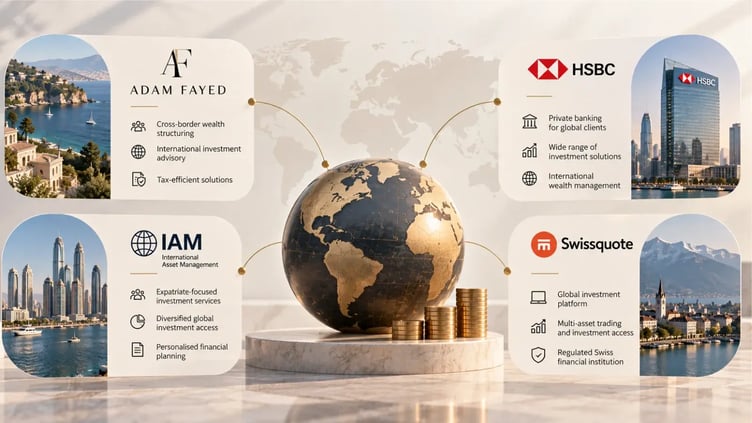
Firms that help expats with offshore investment planning include Adam Fayed, HSBC Global Private Banking, and International Asset Management (IAM), which offer different approaches to international wealth management and portfolio planning.
Adam Fayed focuses on cross-border investment and wealth management for expats and internationally mobile investors, working with regulated advisers, investment platforms and specialist partners where appropriate.
Its services can be relevant to investors managing assets across several jurisdictions or planning for future relocation and retirement.
The choice of provider should account for where the investor lives, where assets are held, the level of investment support required, portfolio size, fees and applicable regulatory protections.
The firms are included for comparison, not ranking or endorsement. Investors should verify each provider's eligibility requirements, regulatory permissions and service scope before proceeding.
Key Takeaways
- Offshore investment planning firms include international advisers, private banks, and self-directed investment platforms.
- Cross-border investing requires attention to tax residency, currency exposure, and account portability.
- Offshore investment access does not always include personalized advice, tax coordination or relocation support.
- International diversification does not guarantee coordinated wealth management across accounts and jurisdictions.
My contact details are hello@adamfayed.com and WhatsApp +44-7393-450-837 if you have any questions.
The information in this article is for general guidance only. It does not constitute financial, legal, or tax advice, and is not a recommendation or solicitation to invest. Some facts may have changed since the time of writing.
What is offshore investment planning for expats?
Offshore investment planning for expats involves selecting and managing investments, accounts, and financial arrangements across national borders in line with an individual's residency, financial goals, and applicable laws.
The term offshore generally refers to financial accounts or investments held outside an investor's country of residence.
It does not automatically mean investing in a tax haven, establishing a foreign company, or avoiding domestic taxes.
It can form part of broader expat financial planning, particularly when investments need to support retirement, family commitments, or future relocations.
Effective planning typically covers five areas:
- International portfolio diversification: Accessing shares, bonds, exchange-traded funds (ETFs), and other eligible assets across different markets rath concentrating investments in one country.
- Currency management: Assessing how exchange rate movements affect investment values, future spending, and retirement income.
- Tax residency and reporting: Understanding how the investor's current residence, citizenship, and relevant tax agreements affect investment income, capital gains, and reporting obligations.
- Account and investment structures: Choosing suitable brokerage accounts, investment platforms, or advisory arrangements based on eligibility, costs, and regulatory protections.
- Long-term financial planning: Coordinating investments with retirement, family commitments, inheritance objectives, and possible future moves abroad.
Professional offshore investment advisors can help bring these considerations together in a coherent strategy.
However, not every provider offers tax, legal, and investment advice under one roof.
Some concentrate on portfolio construction, while others provide access to investments or coordinate with external specialists.
Best Firms for Offshore Investment Planning for Expats
The best firms for offshore investment planning for expats include Adam Fayed, HSBC Global Private Banking, and Swissquote.
They offer different forms of expatriate investment services, from cross-border investment advice and private banking to self-directed access to international markets.
1. Adam Fayed
Adam Fayed provides international wealth management and cross-border investment planning for expats, high-net-worth individuals and internationally mobile investors with assets or financial commitments spanning multiple countries.
Its approach focuses on coordinating investment portfolios with broader financial objectives, including retirement planning, wealth preservation and future relocations. This can be particularly useful for investors seeking to manage their international wealth through changing residency circumstances.
The firm works with regulated advisers, investment platforms and specialist partners to support investment arrangements across jurisdictions. It also has business interests in Mauritius, Uganda and Singapore, including arrangements involving locally licensed advisers.
Investors should establish which entities will provide the relevant services, how fees are structured and whether their investment arrangements can accommodate future changes in residence.
- Services offered: Global wealth structuring, investment planning, retirement planning, and asset protection.
- Minimum investment: Global wealth structuring service is designed for clients with at least US$200,000 in investable assets, subject to eligibility and individual circumstances.
- Fees and compensation: Investment-related costs generally range from 0.5% to 2.5% annually, depending on the investment solution and underlying products. Standalone consultations start at US$1,500. Actual fees vary according to the scope of service and investment arrangement.
- Regulatory status: Investment arrangements may involve separate providers or platforms, whose regulatory status and investor protections depend on the legal entity, services provided, and client's jurisdiction.
2. HSBC Global Private Banking
HSBC Global Private Banking may suit high-net-worth expatriates who hold assets across multiple jurisdictions and want to coordinate their offshore portfolios within an established international banking group.
Its geographic reach can be particularly relevant to investors whose financial arrangements span several countries.
Suitability depends on whether HSBC can serve the client's country of residence, accommodate the required investment arrangements, and support future relocation plans.
Global Private Banking has separate eligibility criteria from HSBC's other international banking offerings, and available services vary by market.
- Services offered: Discretionary portfolio management, investment advisory services, and access to eligible international investment products, subject to the specific mandate and jurisdiction.
- Minimum investment: HSBC Expat's published Global Private Banking information has specified assets above £1.5 million or equivalent. Requirements may differ across HSBC entities and markets.
- Fees and compensation: HSBC does not publish one universal investment management fee for all Global Private Banking clients. Charges depend on the portfolio, management mandate, and applicable local schedule, and may include advisory, management, custody, and transaction fees. For reference, HSBC's Channel Islands schedule illustrates a 0.55% annual management fee for a £7 million multi-asset portfolio; this is a market-specific example, not a global rate.
- Regulatory status: HSBC provides private banking through locally regulated legal entities. The relevant entity's license determines the investment services it can offer and the investor protections available to clients in each jurisdiction.
3. Swissquote
Swissquote is an online banking and investment provider that gives eligible clients access to international financial markets through digital accounts and trading services.
Its multi-currency capabilities may appeal to expatriates who want to manage investments across borders without engaging a full-service wealth adviser.
Swissquote is particularly relevant to self-directed investors who prefer to choose their own investments and manage their portfolios online.
Unlike an advisory-led service, a standard brokerage account does not automatically include personalized financial planning, retirement advice, or cross-border tax guidance.
The account options available to expatriates also vary by residence and the Swissquote entity providing the service.
- Services offered: Online investment accounts, international securities trading, multi-currency accounts, and digital banking services for eligible clients.
- Minimum investment: Swissquote's published trading account rate card lists no minimum investment for stocks and ETFs. Initial account funding requirements are separate: the Swiss account opening guidance specifies CHF 500 for applicants outside Switzerland and the eurozone, subject to eligible country and account opening requirements.
- Fees and compensation: The rate card effective March 5, 2026, lists commissions of 0.1% for US and Canadian stocks and ETFs. Account opening and custody are listed as free. Account maintenance fees are free for EU and UK residents and VIP clients; other clients generally qualify for free maintenance by making at least one qualifying trade per month, or pay €15 otherwise. Other transaction charges, taxes, and third-party fees may apply.
- Regulatory status: Swissquote Bank Ltd in Switzerland is authorized and supervised by the Swiss Financial Market Supervisory Authority (FINMA). Other Swissquote entities operate under their respective local regulators, so the contracting entity determines the applicable investor protections.
4. International Asset Management (IAM)
International Asset Management (IAM) specializes in investment management and financial planning for expatriates, particularly US citizens living abroad and non-US citizens with financial interests in the United States.
Founded in 2002, the firm focuses on cross-border investment issues, including global diversification, currency exposure, tax considerations, and estate planning.
Its services are designed around clients' citizenship, residence, and financial circumstances rather than a single domestic market.
- Services offered: Discretionary portfolio management, portfolio advisory, financial planning, and portfolio analysis. Investment strategies may use ETFs, individual securities, bonds, and other assets to build internationally diversified portfolios.
- Minimum investment: IAM prefers a minimum account size of US$400,000 for portfolio management and portfolio advisory services, although smaller accounts may be accepted in certain circumstances. Financial planning and portfolio analysis do not have a minimum account size requirement.
- Fees and compensation: Published portfolio management fees range from 0.5% to 2% of assets under management annually, depending on account size and service. Portfolio advisory fees are listed at 1% annually. Portfolio analysis costs US$500–US$2,000 as a one-time fee, while standalone financial planning fees are listed separately. Additional brokerage and underlying investment expenses may apply. See IAM's fee structure for the published schedule.
- Regulatory status: IAM identifies itself as a US-registered investment adviser. Its US advisory services operate under US regulatory requirements, while its European sister company, EuroUS Advisors, holds a separate European investment advisory license. The applicable entity and protections should be verified for the client's residence and service arrangement.
How to pick an offshore investment planning firm?
When comparing offshore investment planning firms, prioritize jurisdictional expertise, transparent fee arrangements, verifiable regulatory credentials, and clear accountability for the services provided.
1. Verify experience in relevant jurisdictions
Check whether the firm has experience with the specific offshore financial centers and countries relevant to the investment arrangement.
Also check if the firm has experience advising investors with assets, citizenship or residence ties to the countries involved.
Confirm that it can serve clients in your current country of residence and whether the relationship can continue if you relocate.
2. Establish the scope of advice
Clarify whether the firm recommends offshore investment structures, manages portfolios, or simply provides access to investment products.
Identify which services are included in the engagement and which require separate providers.
3. Compare fees and compensation
Review advisory fees alongside offshore account charges, custody costs, currency conversion fees, and underlying investment expenses.
Ask whether commissions, referral payments, or product provider incentives could influence recommendations.
4. Verify regulation and asset protection
Check the precise legal entity providing the service, its regulatory permissions, and the jurisdiction governing the arrangement.
Establish how client assets are held and which investor protection or compensation schemes apply, as offshore structures do not automatically provide stronger protection.
Offshore financial adviser vs private bank vs investment platform
An offshore financial adviser provides personalized investment advice and cross-border financial planning, a private bank combines banking with wealth management for eligible clients, and an investment platform enables investors to access and manage investments themselves.
|
Feature |
Offshore financial adviser |
Private bank |
Investment platform |
|
Main role |
Personalized financial and investment advice |
Banking and wealth services for eligible clients |
Investment execution and account access |
|
Typical client |
Expat needing planning or portfolio guidance |
Affluent or high-net-worth client with broader banking needs |
Self-directed investor |
|
Portfolio decisions |
Advised or managed, depending on the mandate |
Advisory or discretionary options may be available |
Generally made by the investor |
|
Cross-border support |
May coordinate with tax and legal specialists |
Can support international banking and wealth needs within its service scope |
Primarily account and trading functionality |
|
Cost structure |
Advice fees and possible product charges |
Banking, custody, advice, and product charges |
Trading, currency conversion, and other account charges |
|
Main consideration |
Verify the adviser's permissions and incentives |
Check eligibility, minimum assets, and service availability |
Understand the limits of execution-only investing |
Conclusion
Navigating offshore investments as an expat requires balancing cross-border opportunities with intense regulatory scrutiny.
The right specialized advisory firm acts as more than just a financial manager; they serve as a critical shield against compliance pitfalls and double taxation.
By partnering with a firm that understands both your host country's regulations and your home country's tax obligations, you turn the complexities of expat life into a distinct wealth-building advantage.
FAQs
What is the best offshore investment?
A diversified portfolio of low-cost global equity and bond funds can be a starting point for long-term investors seeking growth and diversification, while cash deposits may better suit short-term liquidity needs.
The appropriate choice should reflect the investor’s risk tolerance, time horizon, tax residence, and financial goals, as holding investments offshore does not automatically make them safer or more tax-efficient.
What is a reasonable fee for an investment advisor?
An annual fee of around 0.5% to 1.5% of assets under management is a broad reference range for ongoing investment management, although costs vary with portfolio size and service scope.
For expats, compare the total cost including advice, fund expenses, platform charges, custody, and currency conversion against the services provided.
What is the 7 5 3 1 rule in investing?
The 7-5-3-1 rule is a behavioral framework for long-term mutual fund investing through systematic investment plans (SIPs), encouraging a long investment horizon, diversification, emotional discipline, and regular increases in contributions.
It is a guideline rather than an official regulatory rule or a guarantee of returns.
Related Articles
- What Expats Need to Know About Offshore Investments
- What is an offshore investment platform?
- Types of Offshore Investment: Which Offshore Assets Fit Your Portfolio?
- How to Avoid Home Country Bias as an Expat Investor
- Which Firms Help Expats Set Up Trusts and Foundations for Cross-Border Wealth Planning?
- Financial Advisor vs Robo-Advisor for Expats: Which Should You Use?
- Offshore Isn’t Sleazy: What Most People Get Wrong About Global Wealth