Setting up a Single Family Office (SFO) in Singapore involves establishing a private entity to manage the investments, wealth, and long-term financial affairs of one ultra-high-net-worth family.
Singapore is a leading jurisdiction for Single Family Offices because of its political stability, sophisticated financial ecosystem, attractive tax incentive schemes, and strong regulatory framework.
An SFO can centralize investment management, succession planning, governance, philanthropy, and other family wealth functions under a single structure.
This article covers:
- What do single family offices do?
- Why set up a family office in Singapore?
- How to establish a single family office in Singapore?
- How much for a single family office?
- What is the minimum wealth for a family office?
- Are family offices regulated in Singapore?
Key Takeaways:
- A Single Family Office manages the investments and affairs of one wealthy family.
- Singapore offers attractive tax incentives for qualifying family office structures.
- Most Singapore family offices combine investment companies, trusts, or Variable Capital Companies (VCCs) with a dedicated management entity.
- Family offices generally become more practical as investable assets grow into the tens or hundreds of millions of dollars.
My contact details are hello@adamfayed.com and WhatsApp +44-7393-450-837 if you have any questions.
We offer bespoke structuring solutions tailored to your situation and have business interests in Singapore, including relationships with locally licensed advisors.
The information in this article is for general guidance only, does not constitute financial, legal, or tax advice, and may have changed since the time of writing.

What is a single family office in Singapore?
A Single Family Office (SFO) in Singapore is a private organization established to manage the wealth, investments, and financial affairs of one family.
Rather than investing directly, the family office oversees investment decisions, coordinates professional advisers, manages risks, and supports long-term wealth preservation across generations.
Unlike banks or external wealth managers that serve multiple clients, a Single Family Office works exclusively for one family.
This allows investment strategies, governance structures, tax planning, succession planning, and philanthropic initiatives to be tailored to the family's specific objectives.
A Singapore Single Family Office may oversee:
- Public market investments
- Private equity
- Venture capital
- Real estate
- Hedge funds
- Family businesses
- Cash management
- Trusts
- Philanthropic foundations
- Art and alternative investments
Many families also use the office to coordinate legal advisers, accountants, tax specialists, investment managers, and trustees operating across multiple jurisdictions.
While there is no single legal definition of a family office under Singapore law, many are structured around investment entities seeking tax incentives under Sections 13O or 13U of the Singapore Income Tax Act.
What is the staff structure of a single family office?
A Singapore Single Family Office is typically structured with a Chief Executive Officer or Managing Director, investment professionals, finance and accounting staff, legal and compliance specialists, tax advisers, operations personnel, and administrative support.
The exact team depends on the family's assets under management, investment activities, and whether the office applies for Singapore's family office tax incentive schemes.
A typical Singapore Single Family Office may include:
| Position | Primary Responsibility |
| Chief Executive Officer or Managing Director | Oversees the overall strategy and operation of the family office |
| Chief Investment Officer | Develops and manages investment strategy |
| Investment Analysts | Research investment opportunities and monitor portfolios |
| Finance and Accounting Team | Financial reporting, budgeting, treasury, and cash management |
| Legal and Compliance Professionals | Regulatory compliance, governance, contracts, and legal matters |
| Tax Specialists | Singapore and international tax planning and reporting |
| Operations Manager | Coordinates daily administration and service providers |
| Family Governance Adviser | Succession planning, family constitutions, and governance |
| Administrative Support | Scheduling, reporting, and family services |
Many Singapore Single Family Offices also outsource certain functions instead of maintaining large in-house teams, including:
- External investment managers
- Lawyers
- Tax advisers
- Auditors
- Corporate secretarial services
- Technology and cybersecurity providers
For family offices seeking Singapore's Section 13O or Section 13U tax incentives, staffing is also part of the eligibility criteria.
Depending on the incentive scheme, the family office may be required to employ at least two or three qualified investment professionals, with at least one being a non-family member, while also meeting minimum local business spending and other economic substance requirements.
What is the structure of a single family office in Singapore?
A Singapore Single Family Office typically comprises a family office management company and one or more investment vehicles.
Depending on the family's objectives, trusts, holding companies, and other entities may also form part of the overall ownership structure.
This separates the management of investments from the legal ownership of assets while allowing flexibility for tax planning, governance, and succession planning.
A simplified structure often looks like this:
Family Members
│
▼
Family Trust (Optional)
│
▼
Holding Company (Optional)
│
▼
Investment Vehicle (Company or VCC)
│
▼
Investment Portfolio
▲
│
Managed by
│
Single Family Office
(Management Company)
Each component serves a different purpose:
| Component | Primary Role |
| Family Trust (optional) | Estate planning, succession, and asset protection |
| Holding Company (optional) | Consolidates ownership of businesses and investments |
| Investment Vehicle | Holds the family's investment assets |
| Family Office Management Company | Provides investment management, administration, reporting, and governance |
| Professional Advisers | Support legal, tax, audit, compliance, and specialist investment matters |
Not every family office requires every layer.
Some families use only a management company and a single investment vehicle, while larger family offices often combine trusts, holding companies, multiple investment funds, and international entities to support cross-border investments and multi-generational wealth planning.
How to set up a single family office in Singapore?
Starting a Single Family Office in Singapore involves establishing the appropriate legal and operational structure to manage a family's wealth.
While each family office is tailored to the family's objectives and assets, the process generally follows several key stages.
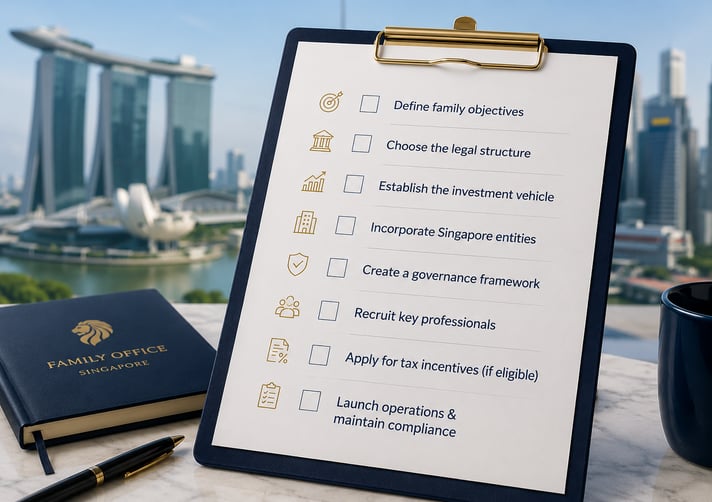
1. Define the family's objectives
Before establishing the family office, the family should determine its primary goals, such as:
-Long-term wealth preservation
-Investment management
-Succession planning
-Philanthropy
-Family governance
-Tax efficiency
-Managing operating businesses
These objectives will influence the legal structure, staffing, and investment strategy.
2. Determine the appropriate legal structure
Determine the appropriate legal structure, including the investment vehicle and family office management company.
Depending on the family's circumstances, the investment vehicle may be structured as:
-A Singapore company
-A Variable Capital Company (VCC)
-A trust
-A combination of these structures
Many ultra-high-net-worth families also incorporate holding companies or offshore entities where appropriate for international investments.
3. Incorporate the Singapore entities
Once the structure has been selected, the relevant Singapore entities are incorporated and registered.
This generally includes preparing constitutional documents, appointing directors, opening corporate bank accounts, and completing the necessary corporate registrations.
4. Develop the investment governance framework
A well-designed governance framework helps separate family ownership from day-to-day investment decisions.
This often includes:
-Investment policy statements
-Risk management policies
-Family constitutions
-Approval authorities
-Succession plans
-Conflict-of-interest policies
-Reporting procedures
Strong governance becomes increasingly important as wealth transfers to future generations.
5. Recruit employees and appoint professional advisers
Once the structure has been established, recruit the necessary investment, finance, legal, tax, compliance, and operations personnel.
Many family offices also outsource specialist functions such as legal advice, tax planning, auditing, trusteeship, and corporate secretarial services.
6. Apply for Singapore family office tax incentives (if applicable)
Families seeking tax exemptions on qualifying investment income typically apply for the relevant incentive under Section 13O or Section 13U.
Applications generally require demonstrating that the family office satisfies the applicable asset thresholds, staffing requirements, business spending commitments, and investment conditions.
7. Begin ongoing operations and compliance
After becoming operational, the family office should maintain proper accounting records, governance procedures, tax filings, and compliance processes.
Who should start a single family office?
A Single Family Office is generally most suitable for ultra-high-net-worth families with substantial investable assets, complex financial affairs, and long-term wealth preservation goals.
The costs and operational responsibilities typically outweigh the benefits for smaller investment portfolios.
Families commonly consider establishing an SFO after major liquidity events such as:
- Selling a business
- Taking a company public
- Receiving a large inheritance
- Building a sizeable investment portfolio
- Managing multiple family businesses
- Expanding investments internationally
A Single Family Office may be appropriate for families that:
- Have diversified assets across several jurisdictions
- Invest in multiple asset classes
- Require succession and estate planning
- Wish to establish formal family governance
- Need dedicated investment oversight
- Value greater privacy and control than traditional wealth management provides
By contrast, families with more modest wealth often find that a Multi Family Office or private bank delivers similar services at significantly lower cost by sharing infrastructure across multiple clients.
How much do you need to have to start a single family office in Singapore?
There is no legal minimum net worth to establish a Single Family Office in Singapore, but many advisers recommend having at least S$20 million to S$50 million in investable assets for it to be economically viable.
While a family office can be established without meeting these incentives, applicants under Sections 13O and 13U must satisfy minimum assets under management (AUM) and other qualifying conditions.
| Tax Incentive | Minimum AUM Requirement |
| Section 13O | At least S$5 million in designated investments at each financial year-end, subject to additional qualifying conditions |
| Section 13U | At least S$50 million in designated investments at application and throughout the incentive period |
Families should also budget for the costs of establishing and operating a Singapore Single Family Office, including:
- Legal and incorporation fees
- Tax and structuring advice
- Corporate secretarial services
- Accounting and audit
- Employee salaries
- Technology and cybersecurity
- Compliance and regulatory reporting
- External investment advisers
Initial setup costs typically range from around S$100,000 to S$500,000, while annual operating costs often start at S$500,000 and can exceed S$1 million, depending on the structure and staffing.
What is the tax incentive for single family office in Singapore?
Qualifying Singapore Single Family Offices can receive a 0% tax rate on specified income and gains from designated investments under the Section 13O and Section 13U tax incentive schemes.
This makes Singapore one of the world's most attractive jurisdictions for managing family wealth.
The main difference between the two schemes is that Section 13O is intended for smaller family offices and has lower minimum AUM requirements, while Section 13U is designed for larger family offices with at least S$50 million in designated investments.
Eligible investment income generally includes dividends, interest, capital gains, and other specified income derived from designated investments, provided the qualifying conditions continue to be met.
Do family offices need to be regulated?
No. Qualifying Single Family Offices in Singapore are generally exempt from licensing by the Monetary Authority of Singapore (MAS), provided they meet the conditions under the licensing exemption framework.
Instead of obtaining a fund management licence, qualifying SFOs are required to notify MAS of their operations, maintain an account with a MAS-licensed bank, and file an annual return with basic operational information.
Even though a license is generally not required, Singapore Single Family Offices must still comply with applicable laws relating to:
- Anti-money laundering (AML)
- Counter-terrorism financing (CFT)
- Tax reporting
- Corporate governance
- Accounting and record-keeping
- Employment regulations
What are the cons of a single family office in Singapore?
A Singapore Single Family Office offers greater control and customization, but it also comes with higher costs and greater operational responsibilities.
Some of the main drawbacks include:
- High setup and operating costs. Legal, incorporation, staffing, compliance, technology, and professional advisory fees can be substantial.
- Ongoing compliance obligations. Family offices must maintain accounting records, tax reporting, corporate governance, and other regulatory requirements.
- Recruitment challenges. Hiring experienced investment professionals, tax specialists, and compliance personnel can be both difficult and expensive.
- Operational complexity. Managing global investments, multiple entities, and cross-border tax matters often requires specialist expertise.
- Limited internal resources. Smaller family offices may rely on a relatively small team, increasing key-person risk and limiting in-house capabilities.
What is the difference between single family office and multiple family office in Singapore?
A Single Family Office manages the wealth of one family, while a Multi Family Office provides investment and advisory services to multiple unrelated families.
The choice largely depends on the family's wealth, desired level of control, and willingness to bear the costs of operating a dedicated office.
| Feature | Single Family Office | Multi Family Office |
| Clients | One family | Multiple families |
| Investment strategy | Fully customized | Customized within shared resources |
| Privacy | Highest | High |
| Control | Complete control | Shared infrastructure and governance |
| Operating costs | Higher | Lower |
| Dedicated staff | Yes | Shared professionals |
| Suitable for | Very large family wealth | High-net-worth families seeking professional management without building their own office |
Conclusion
A Singapore Single Family Office is most effective when family wealth has reached a level where dedicated governance, investment oversight, and succession planning provide long-term value beyond the additional operating costs.
While Singapore's tax incentives and financial ecosystem make it one of the world's leading jurisdictions for family offices, establishing an SFO requires careful planning, appropriate structuring, and ongoing compliance.
Families should evaluate not only their current asset size but also the long-term complexity of their wealth before deciding whether a dedicated Single Family Office is the right solution.
FAQs
Is Singapore the best place for a family holding company?
Singapore is one of the best places to establish a family holding company, but it is not necessarily the best for every family.
The most suitable jurisdiction is based on factors such as the family's tax residency, investment profile, and long-term succession planning objectives.
What is the family office trend in Singapore?
Singapore has experienced significant growth in the number of family offices over the past several years, driven by increasing global wealth, political stability, attractive tax incentives, and its position as a leading financial center in Asia.
The sector continues to attract wealthy families seeking a regional base for managing international investments and multi-generational wealth.
Can a family office be a business?
Yes. A family office is generally operated through one or more business entities, such as a management company and investment vehicle.
However, unlike traditional financial institutions, a Single Family Office primarily manages the wealth of one family rather than providing investment services to external clients.
Is 50 million enough for a family office?
Yes. S$50 million is generally sufficient to establish a dedicated Single Family Office and meets the minimum designated investment requirement for Singapore's Section 13U tax incentive.
Families must still satisfy the scheme's staffing, business spending, and other qualifying conditions, while larger portfolios often make operating a dedicated family office more cost-effective.
Related Articles:
- Single and Multi-Family Offices: 7 Key Differences You Should Know
- Family Office Services Explained: What UHNW Families Really Get
- Singapore Family Office Tax Exemption
- Wealth Management for Singapore Expats: How to Grow and Protect Global Assets
- Singapore External Asset Managers: Services, Regulation & Top Firms