Foreigners can open bank accounts in Singapore, including some people who live overseas, although eligibility, documentation, minimum deposits and available services vary by bank and by the applicant’s circumstances.
For new arrivals, a Singapore bank account can provide the foundation for receiving income and managing daily finances, while overseas non-residents may use Singapore banking for international transfers, SGD holdings, investments or other Singapore-related financial needs.
Key Takeaways
- Opening a bank account does not establish Singapore tax residency or change your tax obligations elsewhere.
- Foreigners living in Singapore generally have more account options than non-residents applying from overseas.
- Account requirements can include a Singapore pass, proof of address, tax-residency information and evidence showing the source of funds.
- Initial deposits, minimum balances and fall-below fees vary by bank and account, so these costs should be compared separately.
My contact details are hello@adamfayed.com and WhatsApp +44-7393-450-837 if you have any questions.
The information in this article is for general guidance only. It does not constitute financial, legal, or tax advice, and is not a recommendation or solicitation to invest. Some facts may have changed since the time of writing.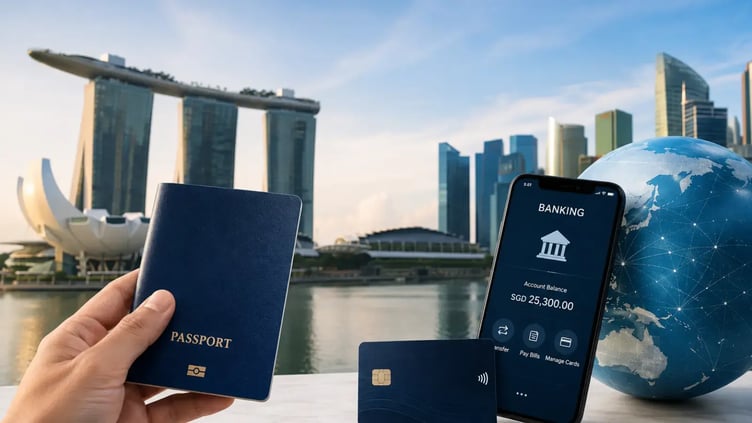
Can non-residents open a bank account in Singapore?
Yes, some Singapore banks allow foreign non-residents to open bank accounts, although eligibility and available account options vary by bank and customer profile.
Foreigners living in Singapore for employment, study or other approved purposes generally have a clearer route to personal banking, with banks typically asking for a valid passport, Singapore pass, proof of address and tax residency information.
Non-residents may also qualify for certain accounts, but banks can apply different requirements, minimum deposits and service restrictions to customers living overseas.
Nationality alone does not determine eligibility.
Banks assess factors such as the customer’s place of residence, tax residency, source of funds and intended use of the account.
How can new arrivals and non-residents open a bank account in Singapore?
New arrivals living in Singapore may be able to apply online or at a branch using their passport, eligible Singapore pass, proof of address and tax-residency information.
People who continue living overseas generally have fewer eligible accounts.
Depending on the bank and account, they may need to apply through a branch or international banking service and provide additional information about their tax residence, source of funds and intended account use.
- Check whether online or branch application is required.
- Prepare your passport, proof of address and tax-residency details.
- Provide a Singapore pass if applicable.
- Submit source-of-funds documents if requested.
- Fund the account using an accepted payment method.
- Complete any additional identity or compliance checks.
What documents are needed to open a bank account in Singapore?
Foreign applicants generally need a valid passport, proof of their Singapore immigration status or residency, proof of address and information confirming their tax residency.
The exact documentation is based on the bank and your circumstances, but foreign applicants should generally be prepared to establish four things:
Identity
A valid passport is typically required for foreign applicants.
Status in Singapore
If you are living, working or studying in Singapore, the bank may request your Employment Pass, S Pass, Student Pass, Dependant's Pass, Long-Term Visit Pass or another qualifying document.
DBS, for example, lists passports and relevant Singapore passes among its supporting documentation for foreign applicants.
Residential address
Banks may require evidence of where you currently live.
Depending on the bank and circumstances, this could include a Singapore utility or telecommunications bill, bank statement, employment documentation or another accepted document.
Tax residency
Foreign customers may need to declare their tax residency and provide supporting documentation.
DBS states that customers with tax residency outside Singapore may be asked for documents supporting their declared tax residence.
Banks can also request additional information where necessary.
Why Singapore banks look beyond your passport
Singapore banks look beyond your passport because financial regulations require them to verify a customer's identity, understand the source and movement of their money, establish tax residency and assess potential money-laundering and other financial-crime risks.
For internationally mobile customers, opening an account is therefore not simply an identity-verification exercise.
A newly arrived employee with a straightforward salary and Singapore Employment Pass may present a relatively simple banking profile.
An overseas investor moving substantial assets into Singapore could face more extensive questions because the bank needs to establish the source of those assets and understand how the account will be used.
The level of scrutiny can therefore vary considerably between customers.
Nationality is only one part of the assessment; residency, tax status, source of wealth, source of funds and expected account activity can all influence the onboarding process.
Singapore banking for new arrivals vs non-residents
New arrivals generally use Singapore banking to establish their day-to-day financial life in the country, while overseas non-residents use it to access Singapore banking services without relocating there.
A new arrival is typically trying to establish a financial base in Singapore.
The account may be used to receive employment income, pay rent and utilities, make local payments, obtain a debit card and gradually build a relationship with a Singapore bank.
A non-resident, meanwhile, may have no intention of relocating.
They may want to hold Singapore dollars, make Singapore-related payments, manage investment options or maintain a banking relationship in the country while continuing to live elsewhere.
This difference affects what matters when choosing an account. A new arrival may prioritize accessibility, mobile banking and salary crediting.
A non-resident may place greater weight on remote onboarding, currency capabilities, international transfers, minimum balances and whether the bank is willing to maintain the relationship without local residency.
Which banks in Singapore are open to foreigners?
DBS/POSB, OCBC and UOB offer banking options for foreign customers, including new arrivals living in Singapore and, for certain accounts, non-residents living overseas.
Five banks commonly worth considering are:
- DBS/POSB — offers dedicated onboarding for foreigners who are new to Singapore, including customers working or studying in the country. Its banking options are particularly relevant to new arrivals who need a local account for salary crediting and everyday expenses.
- OCBC — offers account-opening options for foreign customers, including a Statement Savings Account specifically designed for non-residents. This makes OCBC relevant to both foreigners establishing themselves in Singapore and eligible customers who continue to live overseas.
- UOB — offers savings accounts to foreigners, although some accounts require foreign applicants to apply at a UOB branch and provide original identification and supporting documents. Account availability and requirements vary by the specific product.
- Standard Chartered — offers several accounts to foreigners and has a strong international banking focus, including options for customers who need to manage finances across countries. Some accounts can be opened remotely, although eligibility requirements apply.
- HSBC — offers banking options for foreigners, including accounts available to residents and non-residents. Its international banking services can also be relevant to customers who maintain financial connections across multiple countries.
Acceptance of foreign customers does not mean every applicant will qualify for the same accounts or terms.
How much to open bank account in Singapore
Opening a bank account in Singapore can cost S$0 in account opening fees, but the initial deposit required can range from S$0 to S$3,000 or more based on the bank, account and customer profile.
Some basic accounts have no initial deposit requirement.
-
DBS My Account has no initial deposit or minimum balance requirement and no service charge for customers using electronic statements. A monthly fee can apply if the customer receives hard copy statements.
-
OCBC's current Statement Savings Account information for non-residents specifies a S$3,000 minimum initial deposit, with the first deposit required to come from a bank account in the applicant's name.
-
UOB's Uniplus Account, meanwhile, lists a S$1,000 minimum initial deposit for foreigners.
Other accounts, particularly those designed for non-residents or particular customer segments, can require substantially more.
The important point is that the amount needed to open an account is not necessarily the amount you need to keep in it.
Initial deposits, minimum balances and monthly fees are separate requirements that should be checked before choosing an account.
How much is a monthly bank fee?
Monthly bank fees in Singapore range from S$0 to S$10 or more across different account types. Some accounts have no service charge.
Other accounts charge a fall-below fee when the balance drops below a specified threshold.
OCBC's Statement Savings Account for non-residents has a S$10 fall-below fee, currently waived for the first 12 months.
UOB's Passbook Savings Account charges S$2 when the minimum average daily balance falls below S$500.
Should you keep your existing overseas bank account after moving to Singapore?
Yes, keeping your existing overseas bank account after moving to Singapore can be useful if you still receive income, manage investments or have financial commitments in your home country.
Moving to Singapore does not automatically require you to close your previous bank account.
Maintaining both accounts can also make cross-border transfers and financial administration easier during the transition.
As your financial affairs become more Singapore-based, however, some overseas accounts may become unnecessary, particularly if they carry maintenance fees or no longer serve a practical purpose.
Banking in Singapore while living abroad
Singapore bank accounts can be managed from abroad, but access to online banking does not guarantee eligibility for every account or banking service.
Banks may require customers to keep their personal information and tax-residency details up to date.
DBS, for example, requires customers to self-certify their tax residency under FATCA and CRS rules.
For people who expect to move between countries, it is therefore important to consider how the banking relationship will be maintained when their residency or tax circumstances change.
Conclusion
Singapore banking is most useful when it solves a specific financial need rather than simply giving a foreign customer access to a local account.
For someone settling in Singapore, that may mean building a functional local banking base; for a non-resident, it may mean maintaining access to Singapore while managing finances elsewhere.
The bigger consideration is how the account fits into your wider financial arrangements, particularly when your country of residence, income sources or asset holdings change.
FAQs
Are deposits in Singapore banks protected?
Eligible Singapore dollar deposits are insured by the Singapore Deposit Insurance Corporation for up to S$100,000 in aggregate per depositor at each member institution.
Foreign currency deposits, structured deposits and investment products are not covered by the deposit insurance scheme.
Can a tourist open a bank account in Singapore?
Being permitted to enter Singapore as a tourist does not automatically make someone eligible for a local bank account.
Approval depends on the bank, account, applicant’s country of residence and the bank’s onboarding requirements.
Can I access online banking from abroad?
Yes, Singapore banks generally allow customers to manage their accounts online while abroad, although available services can vary by account and security requirements.
Customers who relocate overseas should also keep their contact details and tax-residency information updated with the bank.
How much money can I bring out from Singapore?
You can take any amount of physical cash or bearer negotiable instruments out of Singapore, but amounts exceeding S$20,000 or its equivalent must be declared electronically.
This requirement applies to physical cash and bearer negotiable instruments, not electronic transfers from a Singapore bank account to an overseas account.
Related Articles
- Wealth Management for Singapore Expats: How to Grow and Protect Global Assets
- Offshore Bank Accounts for Expats
- Best High Interest Savings Account in Singapore: Which Banks Pay the Most?
- Top Investments for British Expats in Singapore
- What is the difference between offshore banking and traditional banking?
- Offshore Banking vs Relationship Banking: What’s the Difference?