Unit trusts in Singapore can be worth buying for investors who want professional fund management and diversification, but their value comes down to fees, fund selection and investment objectives.
DBS/POSB, OCBC and UOB each offer access to unit trusts, yet the bank you use matters less than the specific fund, its costs and how well it fits your portfolio.
Key Takeaways
- Unit trusts offer diversification and professional management, but they can carry higher fees than ETFs.
- There is no single best unit trust in Singapore; the right choice is based on your goals, risk tolerance, timeframe and costs.
- More unit trust choices do not necessarily mean a better portfolio; each fund should have a clear role in your overall investments.
- Fees can significantly affect long-term returns, making total costs an important part of any unit trust comparison.
My contact details are hello@adamfayed.com and WhatsApp +44-7393-450-837 if you have any questions.
The information in this article is for general guidance only. It does not constitute financial, legal, or tax advice, and is not a recommendation or solicitation to invest. Some facts may have changed since the time of writing.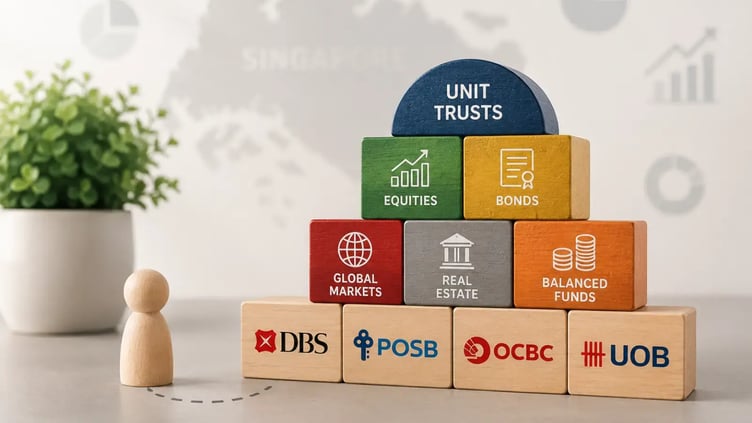
What is a unit trust in Singapore?
A unit trust is a pooled investment where money from multiple investors is combined and managed by a professional fund manager. The fund uses this capital to buy a portfolio of assets according to a stated investment strategy.
When you invest, you purchase units in the fund rather than directly owning each underlying stock or bond. The value of your units generally rises or falls based on the performance of the assets held by the fund.
For example, an equity unit trust may invest in shares across several countries and industries.
Instead of buying dozens of individual stocks yourself, you can gain exposure to the portfolio through a single fund.
In Singapore, unit trusts are commonly available through banks, investment platforms and fund distributors.
DBS/POSB, OCBC and UOB all provide customers with ways to access investment funds, although the funds, charges and investment features available through each bank can differ.
What is the best unit trust fund in Singapore?
There is no single best Singapore unit trust fund, but global equity funds may suit long-term growth, while bond, money market and multi-asset funds may better suit income, lower volatility or capital preservation.
The best choice comes down to the fund's investment strategy, costs and how closely it matches your financial objectives.
A fund with strong recent returns is not necessarily the best fund to buy right now if its fees are high, its risk is unsuitable or its portfolio does not fit your investment horizon.
Before choosing a unit trust, consider:
- Investment objective: Look for funds designed around your goal, whether that is long-term growth, income or capital preservation.
- Asset allocation: Check whether the fund invests mainly in equities, bonds, cash or a combination of assets.
- Geographic exposure: Consider whether you want exposure to Singapore, the US, Asia, emerging markets or a globally diversified portfolio.
- Fees: Review sales charges, management fees and other ongoing expenses, as higher costs can reduce your net returns.
- Performance against its benchmark: Assess how consistently the fund has performed relative to the benchmark it aims to beat or track.
- Risk: Consider volatility and historical drawdowns alongside the fund's stated risk classification.
- Investment horizon: A higher-risk equity fund may be more appropriate for long-term money than funds needed within the next few years.
What types of unit trusts may suit different investors?
|
Investor objective |
Unit trust type to consider |
|
Long-term capital growth |
Global or regional equity funds |
|
Income generation |
Bond or income-focused funds |
|
Lower volatility |
High-quality bond or multi-asset funds |
|
Capital preservation |
Money market or short-duration bond funds |
|
Diversified portfolio |
Multi-asset funds |
DBS vs OCBC vs UOB: How do they compare?
DBS/POSB, OCBC and UOB all offer unit trusts, with DBS and POSB sharing the same investment ecosystem, while OCBC and UOB have their own platforms and fund offerings.
The most useful comparison looks at fund selection, minimum investment, regular investing options, fees and digital investment tools.
|
Factor |
DBS/POSB |
OCBC |
UOB |
|
Fund selection |
200+ unit trusts |
Selected 360 unit trusts |
100+ unit trusts |
|
Minimum investment |
From S$1,000 |
From S$1,000 for selected funds |
From S$500 on UOB TMRW; S$1,000 for selected funds |
|
Regular investing |
From S$100/month via Invest-Saver |
From S$100/month |
From S$100/month |
|
Online sales charge |
0.82% |
0.88% |
Up to 0.8% |
|
Digital access |
DBS digibank |
OCBC Digital |
UOB TMRW |
DBS
DBS may appeal to investors who want more choice within an established banking and investment ecosystem.
Its unit trust offering is broad enough to give investors access to different fund strategies and markets, while DBS digibank keeps investing integrated with everyday banking.
The important consideration is whether the additional fund choice actually helps you build a better portfolio.
A larger menu is not necessarily better if you end up choosing overlapping or unsuitable funds.
POSB customers access unit trusts through the wider DBS/POSB investment ecosystem, so POSB does not need to be assessed as a separate unit trust provider.
OCBC
OCBC may appeal to investors who want to manage unit trusts alongside their existing OCBC banking relationship and access selected funds through OCBC Digital.
What matters is that the funds available through OCBC match your portfolio needs.
A lower account level cost does not automatically make a unit trust cheaper overall if the fund itself carries higher management or other ongoing expenses.
UOB
UOB is particularly relevant for first-time investors who want a relatively low barrier to entry.
Its digital investment setup also makes it easier to combine an initial investment with regular contributions.
For investors who plan to invest consistently over several years, the ability to automate contributions may be more useful than simply having a large number of funds to choose from.
What are the benefits of investing in a unit trust?
Investing in a unit trust can give Singapore investors instant diversification, professional fund management, access to different markets and asset classes, and a convenient way to invest regularly.
Diversification without buying individual securities
A single unit trust can hold dozens or even hundreds of securities, spreading your investment across companies, countries, industries or asset classes.
This reduces the impact that poor performance from one individual investment can have on the overall portfolio.
A global equity fund may hold shares in companies across multiple sectors and markets rather than concentrating your money in a handful of stocks.
Professional fund management
Unit trusts are managed according to a defined investment mandate by professional fund managers.
The fund manager may research companies, assess market conditions, determine asset allocation and decide when securities should be bought or sold.
This can be useful for investors who do not have the time or expertise to research and manage individual investments themselves.
Access to different markets and asset classes
Unit trusts can give investors exposure to markets and asset classes that may be difficult or time-consuming to build independently.
Depending on the fund, investors can gain exposure to:
- Global equities
- Singapore equities
- US or Asian markets
- Government and corporate bonds
- Emerging markets
- Money market instruments
- Property-related investments
- Multi-asset portfolios
This range allows investors to build portfolios around different objectives, from long-term growth to income generation and capital preservation.
Convenient regular investing
Some banks and investment platforms allow investors to make regular contributions to selected unit trusts.
Rather than investing a large amount at once, an investor can contribute a fixed amount periodically.
This provides a straightforward way to make investing part of a long-term financial plan.
Potential for long-term growth or income
Unit trusts can provide opportunities for long-term capital growth, income or both, based on the assets held by the fund.
Equity funds generally offer greater growth potential but also greater volatility.
Bond funds may provide income with comparatively lower volatility, while money market funds generally focus more on liquidity and capital preservation.
The most suitable fund should therefore align with the investor's objective, risk tolerance and investment time frame rather than being selected solely because of strong recent performance.
What are the disadvantages of unit trust in Singapore?
The main disadvantages of unit trusts in Singapore are higher fees, no guaranteed returns, limited control over individual investments and the difficulty of choosing among numerous funds.
The biggest concern for many investors is cost.
Unit trusts can involve several layers of fees, including sales charges, management fees and other fund expenses.
Even relatively small recurring costs can reduce long-term investment returns.
Higher fees than many ETFs
Many unit trusts are actively managed, meaning a professional fund manager makes investment decisions on behalf of investors.
This active management comes at a cost. Many passive ETFs simply track an index and can therefore have lower ongoing expenses.
That does not automatically make ETFs a better choice.
An actively managed unit trust can potentially outperform its benchmark after fees, but investors should consider whether the potential benefits justify the additional cost.
Performance is not guaranteed
Professional fund management does not guarantee higher returns.
A fund manager can make unsuccessful investment decisions, and a unit trust can underperform its benchmark or similar funds.
Market movements can also cause the value of the investment to fall.
Past performance is therefore not a reliable indication of future returns.
Sales charges can reduce your initial investment
Some unit trusts charge an initial sales fee when you purchase units.
For example, if an investor puts S$10,000 into a unit trust with a 0.8% sales charge, S$80 is deducted, leaving S$9,920 invested before ongoing fund expenses.
The investment must then earn enough to recover that initial charge before the investor reaches the same position as an equivalent investment without a sales charge.
Less control over individual holdings
Investors in a unit trust are investing according to the fund manager's strategy.
You generally cannot instruct the manager to remove a particular company from the portfolio or increase exposure to a specific stock.
Investors who prefer choosing individual securities may therefore have greater control through direct investing.
Fund selection can be overwhelming
Singapore investors have access to numerous unit trusts with different strategies, geographic exposures, asset classes, risk levels and fee structures.
Two funds may appear similar while having substantially different portfolios, costs and investment approaches.
Choosing a fund based solely on a bank employee's recommendation, recent performance or the fund's name can therefore lead to an unsuitable investment.
Is unit trust worth buying?
A unit trust is worth buying in Singapore when the fund's potential value justifies its total cost and fits your investment objective.
The key questions are:
- Does the fund fit your objective? Check its strategy, asset allocation, geographic exposure and risk level.
- Are the costs reasonable? Look beyond the sales charge to management fees and other ongoing expenses.
- Is there a cheaper way to achieve the same goal? For similar market exposure, compare the unit trust with lower-cost alternatives such as ETFs.
Higher fees can be justified when an actively managed fund offers a strategy or expertise that adds value beyond what a lower-cost alternative provides.
If the fund simply tracks a broad index, the additional cost may be harder to justify.
For Singapore investors, the bank you use is therefore only part of the decision.
The specific fund, its total cost and what it is designed to achieve should determine whether it is worth buying.
Conclusion
The Singapore unit trust market gives investors plenty of choice, but more choice does not necessarily lead to better investment outcomes.
It can actually make it easier to accumulate funds without a clear reason for owning each one.
A useful mindset is to view a unit trust as a wrapper for an investment strategy, rather than as an investment decision by itself.
Once you look at it this way, the bank, fund name and recent returns become less important than understanding what you are actually adding to your portfolio.
For investors building wealth over many years, that distinction can matter more than finding a fund that happens to be popular today.
FAQs
What is the minimum amount to invest in unit trust?
The minimum investment varies by fund, but Singapore banks such as DBS, POSB, OCBC and UOB offer unit trusts with starting amounts from S$300 to S$1,000.
Check the specific fund's minimum initial and subsequent investment before buying.
Is DBS or OCBC better?
For unit trusts, OCBC offers a wider selection at around 360 funds versus DBS's 200+, but a larger selection does not necessarily make it the better investment.
The better choice is the specific fund that offers the right strategy, risk level and cost for your investment goals.
Which bank is better, UOB or DBS?
For unit trusts, DBS is the better choice if you prioritize fund selection, with 200+ unit trusts versus UOB's 100+; UOB is the better choice if a lower entry point is more important, with lump-sum investments from S$500 on TMRW.
Is a unit trust an ETF?
No. A unit trust and an ETF are different investment structures. Unit trusts are typically bought and sold through a fund provider or platform at the fund's valuation, while ETFs trade on a stock exchange like shares throughout the trading day.
Related Articles
- Exempt Property UNIT Trusts 101: Best Guide
- Singapore Expat Investment Options: Best Investments for Singaporeans Abroad
- How to Invest in Shariah-Compliant ETFs While Living in Singapore
- Top Investments for British Expats in Singapore
- Cost and Investment: Understanding Cost in Investment Decisions
- How Does a Cross-Border Financial Planner Help?