Your cash can lose value in a Saudi bank account when inflation rises faster than the return your money earns.
Even if your SAR balance stays unchanged, its purchasing power can decline as the cost of goods, housing and services increases.
This is most relevant to cash held in accounts paying little or no return; higher-yield savings or deposit products can offset some or all of the inflation effect when their net return keeps pace with price increases.
Key Takeaways
- A stable SAR balance can still lose purchasing power over time.
- Cash returns need to be measured against inflation.
- Expats should separate essential cash reserves from excess cash.
- Currency, liquidity and future financial needs all matter when managing Saudi cash.
My contact details are hello@adamfayed.com and WhatsApp +44-7393-450-837 if you have any questions.
The information in this article is for general guidance only. It does not constitute financial, legal, or tax advice, and is not a recommendation or solicitation to invest. Some facts may have changed since the time of writing.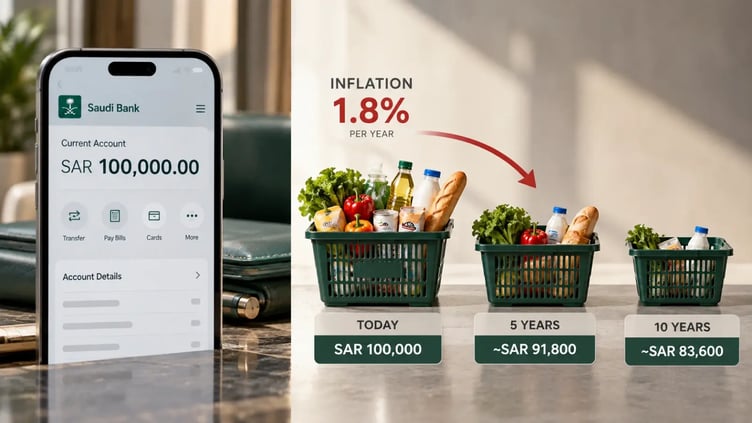
How much purchasing power can cash lose in a Saudi bank account?
Cash loses value through reduced purchasing power, rather than through a visible deduction from your bank balance.
Suppose you keep SAR 100,000 in an account for several years and receive no return.
If prices rise by 1.8% a year, the amount of goods and services that SAR 100,000 can buy gradually declines.
At a constant 1.8% annual inflation rate, SAR 100,000 would have the purchasing power of roughly SAR 91,800 after five years and about SAR 83,600 after 10 years, assuming the account earns no return and ignoring changes in the inflation rate.
This is an illustration rather than a forecast.
If the account earned 3% over the same period while inflation averaged 1.8%, the conclusion would be different.
The cash would not be losing purchasing power on this simplified comparison because its nominal return would exceed inflation, before allowing for any fees or other factors.
Actual inflation will move up and down, and your personal cost of living may rise faster or slower than the national CPI.
The distinction is important:
- Nominal value: The amount shown in your bank account.
- Real value: What that amount can actually buy.
- Return: What the bank or investment pays you for keeping your money there.
- Real return: The return after accounting for inflation.
When does holding too much cash become a problem for Saudi expats?
Holding too much cash becomes a problem when the balance exceeds what an expat reasonably needs for emergencies, near-term expenses and planned financial commitments.
At that point, opportunity cost also becomes relevant because long-term capital held in cash cannot be used for other financial objectives.
This does not mean excess cash should automatically be invested. The appropriate use depends on when the money will be needed, the investor's risk tolerance and future plans.
For example, cash intended for rent, school fees, an upcoming property purchase or a possible relocation has a clear reason to remain liquid. Money accumulated for retirement 15 years away has a very different time horizon.
Gulf expats can also have unusually large cash balances after bonuses, end-of-service benefits, property sales or other lump-sum payments.
Leaving these amounts in an everyday account by default can result in a growing portion of wealth having no defined long-term purpose.
The appropriate cash balance depends on how much needs to remain accessible and how the rest of the money fits into the expat's longer-term financial plans.
How much money should be kept in a Saudi bank account?
Three to six months of essential living expenses is a commonly used starting point for an emergency reserve, but the appropriate amount varies according to employment stability, dependents, upcoming expenses and access to other liquid assets.
A practical framework is to divide cash into three categories.
First, keep enough for regular Saudi expenses. This can include rent, utilities, food, transportation, school costs and other recurring commitments.
Second, maintain an emergency reserve.
The reserve may need to be larger for those with less stable employment, dependents or limited access to other liquid assets.
Third, separate excess cash from money with a defined near-term purpose.
If you have accumulated a large balance that you do not expect to use for months or years, keeping all of it in an ordinary bank account may not be necessary.
For an expat, the calculation should also account for the possibility of leaving Saudi Arabia.
Someone approaching retirement, planning a relocation or preparing for a final exit may need a different cash reserve from someone expecting to remain in the Kingdom for many years.
The objective is not to minimize cash. It is to maintain enough liquidity for your needs while avoiding unnecessary amounts of idle cash.
How can Saudi expats protect the value of excess cash?
Saudi expats can manage excess cash by comparing higher-yield bank products, matching money to different time horizons, considering longer-term investments where appropriate and accounting for future currency needs.
Compare Higher-Yield Options at Saudi Banks
Cash that is not needed for immediate expenses can be compared across savings accounts, time deposits and other deposit products available from Saudi banks.
The key factors are the effective return, minimum balance, withdrawal conditions, fees and how long the stated rate applies.
A higher advertised rate may not necessarily be more suitable if the money is subject to restrictions or other costs.
Match Excess Cash to Different Time Horizons
Money that will remain unused for several years does not necessarily need to stay in the same type of Saudi bank account as short-term savings.
Expats can compare savings accounts, time deposits and other bank products based on when the money will be needed.
Consider Investing Long-Term Excess Cash
Money that is unlikely to be needed for several years can be considered for investment rather than remaining entirely in cash.
Depending on the investor's objectives, time horizon and risk appetite, alternatives can include diversified funds, equities, bonds and other income-producing investments.
Unlike a bank deposit, investments can fall in value and returns are not guaranteed. The reason to consider them is that longer-term capital may have greater potential to generate income or capital growth than cash held in a low-return account.
For Saudi expats, the investment decision should also account for where they may live in the future, which currencies they are likely to spend and whether the investment can continue to be held after leaving Saudi Arabia.
Money needed for emergencies, an upcoming relocation or other near-term expenses should generally remain sufficiently liquid rather than being invested solely to seek a higher return.
Consider Currency Exposure Beyond Saudi Bank Accounts
An expat's future financial commitments may not always be denominated in Saudi riyals.
Because the Saudi riyal is pegged to the US dollar, expats planning future spending in pounds, euros, rupees or other currencies can still face exchange rate movements against the currency they will eventually need.
Someone planning to retire, buy property or relocate to another country may eventually need funds in another currency.
Holding or converting part of their assets into another currency can therefore be considered where it matches a genuine future financial need.
Currency diversification also introduces exchange rate risk and conversion costs, so it should be based on expected financial commitments rather than short-term movements in exchange rates.
Conclusion
Cash still serves an important purpose for emergencies, near-term spending and planned financial commitments. The issue is allowing surplus cash to remain in a low-return account for years without reassessing its purpose.
As an expat's plans change, the amount held in cash, the return it earns and the currency it is held in should continue to reflect where and when that money will eventually be used.
FAQs
Which bank is best for foreigners in Saudi Arabia?
Saudi National Bank, Al Rajhi Bank and Riyad Bank are among the main Saudi banks for foreigners, offering options for everyday banking, international transfers and savings.
Does Saudi Arabian bank charge interest?
Saudi banks use both conventional and Shariah-compliant structures, so returns may be provided as interest, profit rates or profit-sharing arrangements depending on the account.
Expats should check the specific terms of their account to understand how its return is structured.
How much cash can I carry out of Saudi Arabia?
You can carry cash or negotiable instruments worth less than SAR 60,000 without triggering the Saudi declaration threshold; amounts of SAR 60,000 or more, or the equivalent in another currency, must be declared to ZATCA.
The SAR 60,000 figure is therefore a declaration threshold, not an absolute limit on how much cash you can take out of Saudi Arabia.
Related Articles
- Investment Advice for Expats in Saudi Arabia: Tax, Advisors, & Investments
- Send Money Home or Invest in Saudi: Where Does Your Money Grow More?
- 8 Best Investments During Inflation
- Why Expat Investors Misjudge Risk, War, and Global Portfolio Strategy
- Opening a Business Bank Account in UAE: Requirements & Best Banks
- The Guaranteed Returns Trap: How Gulf Expats Get Sold Bad Investments