Wealthy expatriate investment opportunities are often difficult to trust because investing abroad means navigating unfamiliar regulators, legal systems, tax rules, and financial advisors.
Building confidence requires understanding how cross-border investing differs from investing at home and evaluating opportunities beyond projected returns.
Finding investment opportunities is rarely the biggest challenge for globally mobile investors. Knowing which ones deserve your trust is.
Most wealthy expats leave behind more than their home country; they also leave behind familiar financial institutions, regulatory frameworks, and advisors they've known for years.
Suddenly, they are presented with investment products, offshore structures, and financial firms they may have never encountered before.
That uncertainty makes it far harder to distinguish genuinely suitable opportunities from those that simply have convincing marketing.
This article covers:
- Why do wealthy expatriates struggle to trust investments?
- Why is investing abroad different from investing at home?
- Why some international investments appear more trustworthy than they are
- Should you trust impressive historical returns?
- How can expatriates identify reliable investments abroad?
- Why does advisor selection matter in cross-border investing?
- What gives wealthy expatriates confidence when investing internationally?
Key Takeaways:
- Cross-border investing removes many of the familiar signals investors rely on.
- Trust should be built through due diligence rather than marketing claims.
- Reliable investment opportunities prioritize transparency, regulation, and suitability.
- Experienced international advice can improve investment confidence.
My contact details are hello@adamfayed.com and WhatsApp +44-7393-450-837 if you have any questions.
The information in this article is for general guidance only, does not constitute financial, legal, or tax advice, and may have changed since the time of writing.

Why do wealthy expatriates struggle to trust investments?
Wealthy expats may struggle to trust investments because relocating abroad removes many of the familiar reference points they use to judge credibility.
At home, investors usually recognize financial institutions, understand the regulatory environment, and know where to seek independent advice. Those advantages often disappear after moving abroad.
Instead, expatriates may encounter unfamiliar financial firms, offshore investment structures, different regulators, and advisors operating under entirely different legal frameworks.
Even when an investment is legitimate, unfamiliarity naturally creates uncertainty.
This explains why the biggest expat investment challenges often lie in assessing which opportunities deserve confidence, not in finding opportunities themselves.
Why does moving abroad make investing feel riskier?
Moving overseas makes investing feel riskier because familiarity is replaced by uncertainty.
Investors who have spent years building relationships with banks, advisors, and investment providers in their home country suddenly find themselves evaluating businesses they've never heard of.
They may also be exposed to products that simply don't exist in their country of origin.
The investment itself may not be riskier—but making an informed decision becomes more difficult when the surrounding financial ecosystem is unfamiliar.
Why is investing abroad different from investing at home?
Cross-border investing involves more than choosing investments. It requires managing multiple legal, tax, and regulatory environments simultaneously.
Domestic investors usually operate within one financial system; internationally mobile investors often do not.
The latter may need to consider:
- Multiple tax jurisdictions
- Currency exposure
- International reporting requirements
- Estate planning across countries
- Different regulatory protections
- Prospective country move
These additional layers make investment decisions more complex than they first appear.
Why do wealthy expatriates receive conflicting investment advice?
Different advisors often recommend different strategies because they operate under different regulations, business models, and client assumptions.
An advisor in one jurisdiction may recommend products unavailable elsewhere. Another may focus on tax efficiency, while another prioritizes investment flexibility or estate planning.
Rather than assuming one recommendation is correct and another is wrong, expats should understand why the advice differs.
Why can the same investment be suitable for one expat but not another?
What works well for one wealthy expat investor may be inappropriate for another because residency, tax obligations, citizenship, currency exposure, and long-term financial goals vary from person to person.
Two expatriates with identical portfolios may require completely different investment strategies because they have different:
- Countries of residence
- Tax obligations
- Retirement plans
- Citizenship
- Long-term relocation goals
This is one reason why standardized investment recommendations often fall short for internationally mobile families.
Why does portability matter?
Portability is important as it determines whether an investment remains practical if your country of residence changes.
Some investment products become difficult—or impossible—to continue holding after relocating. Others may create unexpected tax or reporting consequences, or restrictions based on your new country of residence.
Before investing, consider questions such as:
- Can I continue holding this investment if I move abroad?
- Will its tax treatment change after relocating?
- Does my new country restrict access to this investment?
- Will I need to sell or transfer it?
For expatriates, investment portability is often just as important as performance because the ability to keep an investment over the long term can be just as valuable as the returns it generates.
Why do some international investments appear more trustworthy than they are?
Some overseas investment opportunities seem more trustworthy than they actually are because investors often rely on visual credibility and familiarity when objective information is limited.
When evaluating unfamiliar providers abroad, polished marketing, impressive branding, or recognizable financial centers can create a false sense of confidence even though they reveal little about an investment's quality or suitability.
Many investment options look highly credible.
They may feature:
- Polished websites
- Sophisticated presentations
- Attractive performance charts
- Well-known financial centers
- Professional sales materials
None of these characteristics is inherently a cause for concern, and many reputable investment firms present themselves professionally.
However, they should be viewed as supporting information rather than evidence that an investment is well regulated, transparent, or appropriate for your financial objectives.
Trust should be based on due diligence, not presentation.
Is past performance considered a good indicator of future performance?
Past performance provides context, but it does not guarantee future results or indicate suitability.
Historical returns rarely tell investors:
- How much risk was taken
- Whether the investment remains appropriate today
- How it fits into a broader financial plan
Returns should therefore be viewed alongside regulation, liquidity, fees, and long-term objectives.
Are offshore investments automatically risky?
No. Offshore investments vary considerably and should be assessed individually rather than judged solely by where they are based.
Some offshore jurisdictions maintain strong regulatory standards, while others provide fewer investor protections.
The quality of the investment, not simply its location, should drive the decision.
How can expats tell reliable investments abroad?
Reliable investment for expats typically combines strong regulation, transparent fees, realistic expectations, and suitability for an investor's financial objectives.
Instead of searching for the highest projected return, wealthy expatriates should evaluate whether an investment supports their broader financial circumstances.
A useful checklist includes:
- Regulatory oversight
- Tax efficiency
- Diversification
- Liquidity
- Portability across jurisdictions
- Transparent costs
- Long-term suitability
Each factor contributes to building confidence that an investment can continue supporting your financial goals, even if your country of residence changes.
How to verify if investment is regulated
Investors should confirm which regulator oversees both the provider and the investment itself.
Useful questions include:
- Which authority supervises the firm?
- Where is the investment domiciled?
- Are client assets segregated?
- What investor protections apply?
Understanding the answers helps establish whether appropriate safeguards exist.
What makes an investment suitable?
A suitable investment supports your financial targets, risk appetite, tax position, and future plans.
Suitability should consider:
- Investment time frame
- Income needs
- Tax residency
- Currency exposure
- Estate planning
- Future mobility
- Withdrawal strategy
Should liquidity influence your investment decision?
Yes. Liquidity determines how easily you can access your money if circumstances change.
This becomes particularly important for expatriates who may relocate, purchase property, or experience changing family circumstances.
Why is choosing the right advisor harder for wealthy expats?
Choosing an advisor becomes more challenging when financial decisions span multiple countries instead of one.
International investing requires expertise beyond traditional portfolio management.
Local vs international financial advisor
If your assets, income, tax obligations, or future plans span multiple countries, an international financial advisor may be better equipped to address those complexities.
A local financial advisor may be appropriate if your financial affairs are largely concentrated in one country.
However, if you expect to relocate, hold assets in multiple jurisdictions, or have cross-border tax and estate planning considerations, experience with international financial planning can become increasingly important.
The right advisor should understand:
- International taxation
- Multiple regulatory systems
- Currency considerations
- Future relocation planning
- Global investment structures
How do you know an advisor understands cross-border investing?
Look beyond credentials and examine experience.
Ask questions such as:
- Which countries do you regularly advise clients in?
- How do you adapt strategies when clients relocate?
- How do you coordinate tax and investment planning?
Clear, practical answers often reveal more than qualifications alone.
What gives wealthy expats confidence when investing internationally?
Confidence comes from following a disciplined investment process rather than trying to eliminate uncertainty.
Every investment carries risk. The objective is not to avoid uncertainty altogether but to make informed decisions despite it.
For wealthy expatriates, confidence rarely comes from finding the "perfect" investment.
It comes from knowing that every important question has been asked, every reasonable risk has been considered, and each investment supports a broader financial strategy.
That mindset allows investors to make decisions with greater conviction, even when markets remain unpredictable.
Why is process more important than predictions?
Investment success is usually driven by consistent decision-making rather than accurately predicting markets.
While no one can forecast every market movement, investors can control how they evaluate opportunities, manage risk, and adapt to changing circumstances.
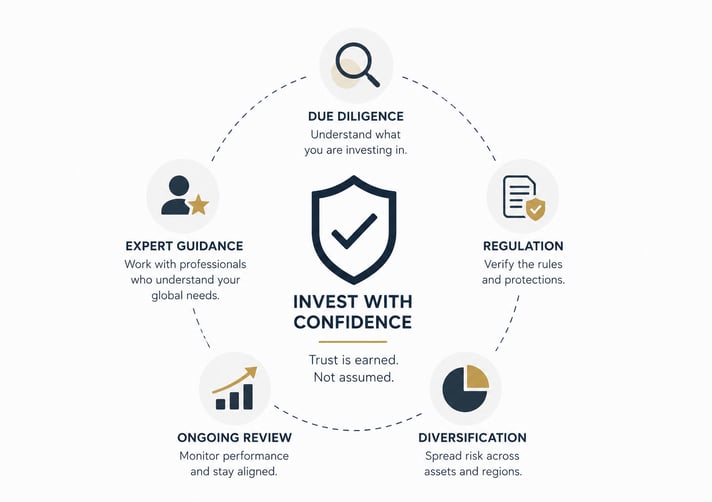
A disciplined process includes:
- Performing due diligence
- Diversifying appropriately
- Reviewing investments regularly
- Reassessing suitability after relocation
- Working with experienced professionals when necessary
Over time, this approach shifts the focus from chasing certainty to building confidence through preparation.
Rather than relying on familiarity, marketing, or short-term market predictions, wealthy expatriates can make investment decisions based on evidence and well-defined financial targets.
Bottom Line
Trust is one of the biggest obstacles facing expat investors. While there are many wealthy expatriate investment opportunities around the world, confidence should be built through transparency, regulation, due diligence, and suitability—not familiarity or marketing.
By understanding why cross-border investment risks make international investing feel more uncertain, wealthy expats can distinguish credible opportunities from persuasive marketing and invest with greater clarity.
FAQs
What is the biggest expat investment challenge?
One of the biggest expat investment challenges is determining whether an investment remains suitable across different jurisdictions and future relocations.
Does professional marketing make an investment trustworthy?
No. Professional marketing alone does not make an investment trustworthy or suitable. Strong branding, polished websites, and persuasive sales materials can create a positive first impression, but they should never replace independent due diligence.
Marketing explains why an investment deserves your attention. Due diligence helps determine whether it deserves your money.
Should expats avoid offshore investments?
No. Offshore investments are not fundamentally better or worse than domestic investments and should be evaluated on their own merits.
Factors such as regulatory oversight, fees, investor protections, tax implications, and suitability are generally more important than whether an investment is based offshore.
Related Articles
- How Expats Can Find Reliable Investment Opportunities in 2026
- Expat Wealth Planners: Why International Expertise Matters
- How to Choose an Expat Financial Advisor You Can Trust
- Top Wealth Managers for Expats in 2026
- Top 10 Financial Advisors for Expats in 2026