The best investments for retiring expats include globally diversified equity funds, high-quality bonds, cash reserves, dividend-paying stocks, income annuities and selected real estate investments.
The right portfolio balances retirement income, capital preservation, and long-term growth while accounting for cross-border taxes, currency risk, and the cost of living abroad.
Key Takeaways
- Dividend stocks and annuities can generate income, but payments are not always guaranteed.
- Inflation-linked bonds help protect purchasing power, though currency and local inflation can affect results.
- REITs offer property exposure without the management demands of direct ownership.
- High withdrawals during market downturns can accelerate portfolio depletion.
My contact details are hello@adamfayed.com and WhatsApp +44-7393-450-837 if you have any questions.
The information in this article is for general guidance only. It does not constitute financial, legal, or tax advice, and is not a recommendation or solicitation to invest. Some facts may have changed since the time of writing.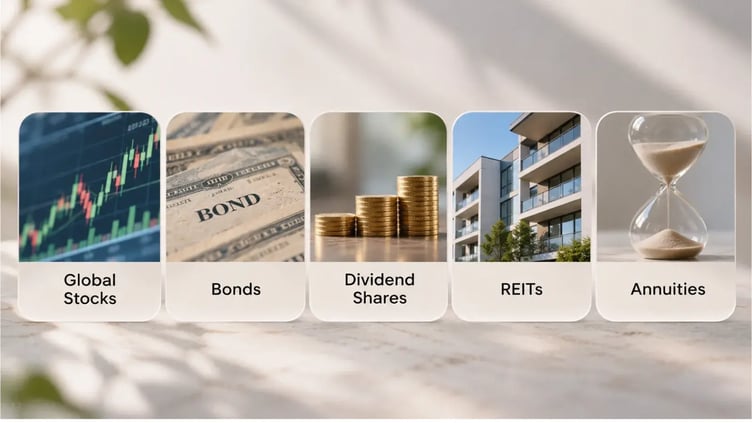
Which investments are suitable for expats who are approaching or already in retirement?
Globally diversified stocks and ETFs, high-quality bonds, cash deposits, dividend-paying stocks, real estate, and annuities are among the investments suitable for retiring expats.
Expats approaching retirement may still need growth-oriented investments to build wealth, while those already retired may prioritize income and capital preservation.
However, retirement does not necessarily mean eliminating exposure to growth assets.
A retirement lasting 25 to 30 years or longer can leave substantial time for investments to recover from market downturns and potentially outpace inflation.
The following investments serve different purposes within a retirement portfolio, each with distinct advantages and limitations.
1. Global Stocks and Exchange-Traded Funds
Global stocks and diversified exchange-traded funds (ETFs) can help retirees maintain long-term growth and diversify across countries and industries.
A global equity ETF provides access to hundreds or thousands of companies through a single investment, making it a convenient option for expats who want to maintain international exposure after relocating.
Advantages:
- Potential for long-term capital appreciation and returns that outpace inflation.
- Broad diversification across countries, sectors, and companies.
- Relatively low costs and convenient access to global markets through ETFs.
- Continued growth potential for retirees with longer investment horizons.
Disadvantages:
- Stock prices can fall significantly during market downturns.
- Selling equities to fund living expenses during a downturn can accelerate portfolio depletion.
- Foreign investments can introduce currency risk, even when the underlying companies operate globally.
- Some ETFs may be restricted based on an expat's country of residence or tax status.
Equities are generally more volatile than bonds and cash.
Retirees should keep near-term spending in more liquid, lower-risk assets while retaining an appropriate equity allocation for long-term growth and potential wealth transfer.
2. Government and Investment-Grade Bonds
Government and investment-grade corporate bonds can provide regular income and reduce portfolio volatility.
Retirees can hold individual bonds, bond funds, or bond ETFs.
Individual bonds held to maturity offer more predictable repayment, provided the issuer remains able to pay.
A bond ladder spreads maturities across several years so principal repayments can help cover planned withdrawals. Expats can also match the currency of those repayments to the expenses they expect to pay.
Advantages:
- Regular interest payments can supplement pension income.
- High-quality bonds generally carry less credit risk than high-yield bonds.
- Individual bonds can be matched to anticipated spending needs.
Disadvantages:
- Prices can fall when interest rates rise.
- Fixed payments may lose purchasing power due to inflation.
- Corporate and government bonds still carry issuer risk.
- Foreign currency bonds expose retirees to exchange rate fluctuations.
Expats should consider the currency of their retirement expenses when choosing bonds.
High-yield bonds may offer greater income but carry higher default risk.
3. Dividend-Paying Stocks
Dividend-paying stocks can provide income and potential capital appreciation.
However, dividends are not guaranteed, and share prices remain exposed to market volatility.
Advantages:
- Dividends can supplement pension income.
- Established companies may offer income and long-term growth.
- Growing dividends may help offset inflation.
- Investors retain ownership of shares while receiving distributions.
Disadvantages:
- Companies can reduce or suspend dividends.
- High-dividend stocks may be concentrated in certain sectors.
- Foreign dividends may be subject to withholding taxes.
Retirees should avoid relying heavily on dividend stocks, as sector concentration can increase risk.
These investments are best held within a diversified portfolio alongside bonds and cash reserves.
Expats should also assess dividend income after applicable withholding taxes.
4. Cash Deposits and Money Market Funds
Cash deposits and money market funds can serve as a reserve within a retirement portfolio.
Expats may also hold cash in currencies that match their expected spending.
Advantages:
- Easy access for everyday expenses and emergencies.
- Lower price volatility than equities and longer-term bonds.
- Bank deposits may qualify for deposit protection, subject to local limits and eligibility.
Disadvantages:
- Returns may not keep pace with inflation.
- Falling interest rates can reduce income.
- Large cash holdings can limit long-term growth.
- Money market funds are investments and may not be covered by deposit insurance.
Cash is generally best reserved for near-term expenses rather than long-term retirement funding.
The appropriate amount should balance liquidity needs against the risk of inflation eroding its value.
5. Real Estate and Real Estate Investment Trusts
Retirees can invest in property directly or through real estate investment trusts (REITs).
Direct ownership involves purchasing and managing property, while REITs provide exposure through listed or traded investments.
Advantages:
- Real estate may diversify a portfolio of stocks and bonds.
- Property values and rents may rise with inflation over time.
- REITs provide property exposure without direct ownership responsibilities.
Disadvantages:
- Direct ownership requires capital and may involve maintenance, vacancies, and management costs.
- Property is generally less liquid than listed investments.
- Prices and rental income can decline.
- Overseas ownership may involve additional taxes, legal restrictions, and currency risk.
- Listed REITs are exposed to market volatility and interest-rate changes.
If you plan to use rent for retirement spending, estimate what you’d actually receive after vacancies, repairs, management fees and taxes. If the rent is paid in another currency, allow for exchange rate changes in your budget.
6. Annuities
Annuities are insurance products that convert a lump sum or series of payments into a stream of income, which may last for a fixed period or for life.
An income annuity can cover part of the gap between reliable pension income and essential expenses. For expats, the payout currency matters. A fixed payment in one currency can cover less of your monthly budget if you spend in another.
Advantages:
- Certain annuities provide guaranteed lifetime income.
- They can help manage the risk of outliving retirement savings.
- Some offer survivor benefits or inflation-linked payments.
Disadvantages:
- Upfront premiums and fees can be substantial.
- Many products restrict access to the capital after purchase.
- Fixed payments may lose purchasing power over time.
- Guarantees depend on the insurer’s financial strength.
- Cross-border tax rules and payment restrictions may affect expats.
7. Inflation-Protected Investments
Inflation-linked bonds, including US Treasury Inflation-Protected Securities (TIPS), adjust their principal or payments according to a specified inflation measure.
Other countries issue similar securities linked to their own price indexes.
Advantages:
- Can help preserve purchasing power against the inflation measure tracked.
- Some government-issued bonds carry relatively low credit risk.
- Can complement conventional bonds and equities.
Disadvantages:
- Market prices can fluctuate as interest rates change.
- The tracked inflation measure may not match a retiree’s actual living costs.
- Foreign currency holdings can introduce exchange rate risk.
- Returns may be less attractive when inflation is low.
TIPS track US inflation, not the cost of living in an expat’s retirement destination.
Someone living in Thailand or France may therefore face a mismatch between the bond’s adjustment and local expenses.
Retirees should assess the relevant inflation index and currency before investing.
What is the best portfolio allocation for retirees?
A moderate retirement portfolio might allocate 40% to global equities, 40% to bonds, 10% to cash, and 10% to real estate or other diversifying assets.
This is only an illustration; the appropriate mix is based on the retiree’s time horizon, income needs, risk tolerance, and other assets.
A retiree whose pension covers essential expenses may be able to hold more equities.
Someone relying on portfolio withdrawals may need more defensive assets and a larger cash reserve.
When deciding how much your portfolio needs to provide, account for pension income, net rent and any savings set aside for retirement spending.
For example, an expat who spends €3,000 a month and receives a pension worth €2,000 in another currency has a €1,000 monthly shortfall at the current exchange rate.
That gap gives them a starting point for sizing a cash reserve in euros. If the pension currency weakens against the euro, the portfolio may need to cover more.
Balancing Growth, Income, and Capital Preservation
Retirement portfolios need to balance three objectives:
- Growth: Equities and diversified funds can help savings keep pace with inflation over a long retirement.
- Income: Bonds, dividend-paying investments, rental properties, and annuities can contribute to cash flow.
- Capital preservation: Cash and high-quality bonds can reduce the need to sell volatile investments during market downturns.
The balance may shift throughout retirement, but age alone should not determine the allocation.
Maintaining a Cash Reserve
Cash reserves can cover near-term expenses during market downturns, reducing the need to sell long-term investments at a loss.
Some retirees use a bucket approach, separating assets by time horizon:
- Short-term: Cash for immediate spending.
- Intermediate-term: Short-duration bonds or other relatively stable investments.
- Long-term: Equities and growth assets for future needs.
The size of each bucket should reflect expected expenses, reliable income, and risk tolerance.
Reviewing and Rebalancing the Portfolio
Different investment returns can move a portfolio away from its intended allocation.
Periodic rebalancing restores the target mix by reducing overweighted assets and adding to underweighted ones.
Expats should also review their portfolio when their tax residency, investment account access, or retirement spending currency changes.
What is the number one mistake retirees make?
One of the biggest retirement investing mistakes is withdrawing too much during the early years of retirement, particularly when markets are falling.
Large withdrawals combined with investment losses can permanently reduce the portfolio’s ability to recover.
This is known as sequence-of-returns risk.
Retirees can reduce this risk by:
- Setting a sustainable withdrawal rate based on their savings, expected lifespan, and other income.
- Keeping enough liquid assets to cover near-term expenses.
- Avoiding unnecessary withdrawals during market downturns.
- Reviewing spending and portfolio performance regularly.
Another common mistake is underestimating inflation, healthcare costs, or the financial implications of relocating.
Expats should plan for expenses in their retirement destination and avoid relying solely on a fixed income estimate.
Conclusion
Retirement investing is ultimately about what money makes possible — security, independence, and the freedom to make choices in later life.
For expats, that freedom may also mean deciding where to live, whether to return home, or how to support family across borders.
A successful strategy is not defined by portfolio performance alone, but by whether it supports the kind of retirement its owner wants to have.
FAQs
What is the 7% rule for retirement?
The 7% rule suggests withdrawing 7% of a retirement portfolio in the first year, but it is not a widely accepted sustainable withdrawal guideline and may be too high for a long retirement.
The 4% rule is more commonly cited, though it is also a guideline rather than a guarantee.
What investments should I use first in retirement?
Retirees generally use liquid, lower-risk assets such as cash reserves and short-term, high-quality bonds to cover near-term expenses, while leaving growth investments for longer-term needs.
Tax rules, account restrictions, and income sources can affect the withdrawal order, particularly for expats.
What is the 30/30/30/10 rule for retirement?
The 30/30/30/10 rule is an informal allocation approach that divides a portfolio into four categories, with 30% in each of three categories and 10% in the fourth. Since the categories vary across sources, it has no single standard definition.
What is the 80/20 rule for retirement?
The 80/20 rule often refers to a portfolio holding 80% in equities and 20% in bonds or other defensive assets, making it a growth-oriented allocation with potentially significant volatility.
It may suit retirees with long time horizons and sufficient capacity to withstand losses, but can be too aggressive for those relying on regular withdrawals.
Related Articles
- Expat Retirement Planning Firms Compared
- 10 Questions to Ask an Expat Financial Advisor Before Investing
- Best Investments for Expats with $500,000 or More
- Best Investments for Expats Without Buying Property
- Why Guaranteed Returns Can Be a Trap for Expats
- When Can You Afford to Retire as an Expat?
- Retiring Abroad: Can You Afford It as You Get Older?
- SEQUENCE RISK EXPLAINED: Same $1 million. Same fund. Same withdrawals. So why is one retiree worth nearly $10 million and the other almost broke?