Finding reliable expat investments starts with evaluating the investment provider—not chasing the highest returns.
The safest opportunities are typically offered by regulated firms with transparent fees, tax-efficient structures, and investment solutions that align with your country of residence, long-term targets, and cross-border obligations.
Because expatriates often invest across multiple tax jurisdictions and currencies, factors such as regulatory oversight, reporting obligations, and currency exposure are just as important as investment performance.
This Article Covers:
- How can expatriates identify trustworthy investment providers?
- What should expats look for before investing overseas?
- Which risks matter most when investing across borders?
- How do FATCA and the Common Reporting Standard affect expat investors?
- What questions should you ask an international financial advisor?
- How can expatriates build a diversified global investment portfolio?
Key Takeaways:
- Reliable investments combine regulation, transparency, tax efficiency, and diversification.
- Always verify a provider's regulatory status before investing.
- Cross-border tax and jurisdiction risks are as important as investment returns.
- A disciplined investment strategy is more valuable than chasing high-performing products.
My contact details are hello@adamfayed.com and WhatsApp +44-7393-450-837 if you have any questions.
We work with expats and internationally mobile investors, including through relationships with locally licensed advisors where required.
The information in this article is for general guidance only. It does not constitute financial, legal, or tax advice, and is not a recommendation or solicitation to invest. Some facts may have changed since the time of writing.

Is finding reliable expat investments hard?
Finding reliable investments is more complex for expatriates because financial decisions often span multiple countries, currencies, and tax systems.
Expatriates face investment challenges that domestic investors rarely encounter.
Your tax residency may be uncertain. Your income might be denominated in one currency while your long-term goals are in another.
The financial products available in your country of residence may not align with your home country's tax treatment.
They may also be subject to reporting requirements in multiple jurisdictions while navigating investment products that receive different tax treatment depending on where they live.
These complexities create opportunities for unsuitable financial advice.
Some firms specifically target expats with high-fee products or unsuitable investment structures, knowing that cross-border clients often lack access to the regulatory protections available to domestic investors.
Rather than searching for the best investment, expats should focus on identifying investments that remain suitable regardless of future relocation, changing tax residency, or evolving financial targets.
What makes an expatriate investment reliable?
A reliable expat investment combines regulatory oversight, transparent costs, tax compatibility, and appropriate diversification.
International investment reliability goes beyond expected returns.
Higher returns alone do not make an investment reliable. Instead, investors should evaluate opportunities using several objective criteria before committing capital.
Why is investment fee transparency important?
Transparent pricing helps investors understand the true cost of building long-term wealth.
Many internationally marketed investment products include multiple layers of fees, including advisor charges, platform costs, fund management fees, administration fees, and currency conversion costs.
Although each fee may appear modest on its own, their combined effect can substantially reduce long-term portfolio growth.
Investors should request a complete written breakdown of every recurring and one-time charge before proceeding.
Compare these costs against lower-cost alternatives. For example, a 1.5% annual fee difference compounded over 20 years can reduce your final portfolio value by 25% or more.
That said, the objective isn't simply to minimize fees but to ensure the overall value of the advice, investment strategy, and ongoing service justifies the cost.
Transparent providers should be able to explain that value clearly before you invest.
What questions should you ask about fees?
Ask for every fee in writing before investing. A comprehensive fee review should include:
- Initial advisor fees
- Ongoing management charges
- Platform fees
- Custody fees
- Underlying fund expenses
- Exit charges
- Currency conversion costs
Understanding total ownership costs allows investors to compare competing solutions on a like-for-like basis rather than focusing solely on advertised returns.
How do compensation models affect advice?
Understanding how an adviser is paid helps identify potential conflicts of interest.
Some advisors receive commissions from investment providers, while others charge transparent advisory fees directly to clients.
Neither model automatically determines the quality of advice, but investors should understand whether compensation could influence product recommendations.
Independent discussions about costs and incentives often reveal whether advice is centered on long-term client outcomes or product sales.
Why should tax compatibility influence investment decisions?
The most suitable investment is one that works with your tax residency rather than creating unnecessary tax liabilities.
What's tax-efficient in one jurisdiction may trigger punitive taxation in another.
Offshore bonds, retirement accounts, trusts, and collective investment structures may all have different reporting obligations depending on where an expatriate lives and pays taxes.
Before investing, understand how the investment will be taxed today and how its treatment may change if you relocate in the future.
Why is diversification essential for expatriates?
Diversification reduces the impact of cross-border investment risks that become more significant when living internationally.
Expatriates often face additional risks beyond market volatility, including currency fluctuations, political uncertainty, changing tax rules, and regulatory differences between countries.
A diversified portfolio spreads exposure across:
- Asset classes
- Geographic regions
- Investment sectors
- Currencies
- Investment managers
Diversification cannot eliminate risk, but it reduces dependence on any single investment or jurisdiction.
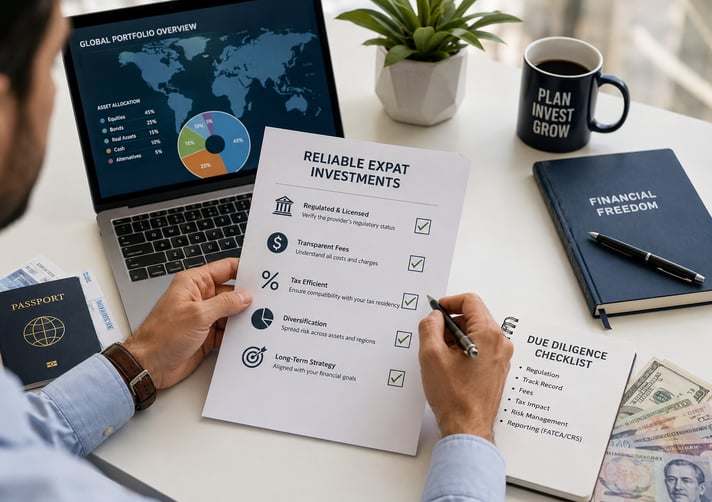
How to check if the investment company is legit?
The best way to check if an investment provider is legitimate is to verify its regulatory status with the relevant financial authority.
Financial authorities include the Securities and Exchange Commission (SEC) in the United States, the Financial Conduct Authority (FCA) in the United Kingdom, the Monetary Authority of Singapore (MAS), or the Dubai Financial Services Authority (DFSA).
A regulated advisor or investment provider is generally subject to licensing standards, compliance requirements, and consumer protection rules.
Don't rely on a firm's website alone. Unregulated or lightly regulated providers expose you to counterparty risk that's difficult to recover from if things go wrong.
A structured due diligence process is one of the most effective ways to avoid unsuitable investments and financial scams.
How to research an investment provider?
Confirm both the firm's registration and the individual advisor's qualifications.
Regulation alone does not guarantee quality advice, but it provides an important layer of accountability.
Rather than relying on sales presentations or performance projections, investors should evaluate providers using objective criteria.
Independent research should include disciplinary history, client complaints where publicly available, and the firm's operating history.
What warning signs should expatriates avoid?
High-pressure sales tactics are often stronger indicators of risk than market performance.
Be cautious if a provider:
- Guarantees investment returns.
- Pressures you to invest immediately.
- Avoids discussing fees.
- Cannot clearly explain tax implications.
- Recommends products before understanding your financial objectives.
- Discourages independent verification of regulatory status.
Reliable advisors encourage informed decision-making rather than urgency.
What risks should expatriate investors consider?
Even well-chosen investments can underperform if you overlook jurisdiction, currency, or tax risks. Understanding these risks helps you avoid costly surprises after you invest.
Unlike market risk, these factors are unique to investing across borders.
A well-performing investment can still create poor outcomes if it is held in an unsuitable jurisdiction, denominated in the wrong currency, or structured inefficiently for your tax residency.
Understanding how these risks interact is essential for building a portfolio that remains effective as your circumstances change.
What is jurisdiction risk and why does it matter?
Jurisdiction risk refers to the political, legal, and regulatory environment where your investments are held.
Political instability, capital controls, weak legal systems, or inconsistent financial regulation can all affect your ability to access investments or enforce your rights if disputes arise.
When evaluating an investment jurisdiction, consider:
- Political and economic stability
- Strength of the legal system
- Investor protection rules
- Regulatory oversight
- Tax treaty network with your country of residence
Jurisdictions with established legal systems and well-developed financial regulations generally provide stronger investor protections than those with limited regulatory oversight.
How does currency risk affect expatriate investments?
Investment performance depends on both asset returns and currency movements. For example, an investment that gains 8% in US dollars may still lose value when converted into pounds or euros if the dollar depreciates significantly during the same period.
Consider how your income, future expenses, and retirement plans are distributed across different currencies.
Where appropriate, diversifying currency exposure or using currency-hedged investments may help reduce volatility, although hedging also introduces additional costs.
Why is cross-border tax compliance essential?
Meeting your tax reporting obligations is just as important as choosing the right investments.
International tax transparency has increased significantly in recent years.
Depending on your citizenship and tax residency, you may need to report overseas accounts, investment income, and financial assets to one or more tax authorities.
For example, US citizens and many US tax residents remain subject to the Foreign Account Tax Compliance Act (FATCA).
Meanwhile, more than 100 jurisdictions participate in the OECD's Common Reporting Standard (CRS), which enables the automatic exchange of financial account information between participating tax authorities.
Rather than pursuing aggressive tax strategies, expatriates should focus on legitimate tax efficiency through appropriate account structures, careful investment selection, and professional advice where necessary.
How can expats maintain a resilient investment?
A successful expat investment strategy is built around long-term goals rather than individual products.
The most reliable portfolios are designed to remain suitable as your career, country of residence, and financial circumstances evolve.
How should you structure your portfolio?
Review your portfolio regularly to ensure it still reflects your financial goals, country of residence, and risk appetite.
International careers often involve relocation, changing tax residency, or new financial priorities that can affect investment suitability.
Once those objectives are clear, diversify across asset classes, regions, sectors, and currencies rather than concentrating your portfolio in a single market or investment theme.
Why is liquidity important to investors?
Maintaining accessible capital provides flexibility when living internationally.
Holding sufficient liquid assets can reduce the likelihood of selling long-term investments during unfavorable market conditions.
What common mistakes should expatriates avoid?
Many investment mistakes stem from poor due diligence rather than poor market performance.
Some of the most common pitfalls include:
- Choosing providers based on sales presentations instead of independent research.
- Underestimating the long-term impact of fees.
- Ignoring currency exposure.
- Failing to consider future relocation or repatriation.
- Overlooking estate planning for assets held across multiple jurisdictions.
Avoiding these mistakes is often more valuable than trying to identify the highest-performing investment.
When should you work with an expat financial advisor?
Professional advice can be valuable when you need to manage wealth across multiple countries or tax jurisdictions.
Expatriates often need guidance that extends beyond investment selection.
Tax residency, retirement planning, estate planning, currency management, and international reporting requirements frequently require coordinated expat financial planning.
Financial advisors who regularly work with high net worth expatriates are generally better positioned to assess how investment decisions interact with global tax rules and changing residency status than advisors whose practice focuses primarily on domestic clients.
Professional advice should complement, not replace, your own due diligence.
Before engaging any advisor, verify their qualifications, regulatory status, fee structure, and whether their services are appropriate for your financial objectives and circumstances.
What questions should you ask an investment provider?
Before investing, ask questions that clarify the provider's regulation, fees, tax implications, and how the investment fits your long-term plans.
Clear, direct answers and a willingness to provide supporting documentation are often good indicators of transparency.
- What regulatory body oversees your firm? Verify the answer independently. Don't accept vague responses.
- What are the total annual costs, including all fees and charges? Get this in writing. Include management fees, platform fees, fund charges, and any other costs.
- How is this product taxed in my country of residence and my home country? The provider should be able to explain the tax implications clearly. If they can't, they may not understand your situation well enough to advise you.
- What happens to my investments if I move to a different country? Your investments should be portable. Understand any limitations or complications that could arise from future relocations.
- How are you compensated? Understand the advisor's incentives. Commission-based compensation creates potential conflicts of interest.
- What are the exit terms? Know the costs and restrictions associated with withdrawing your funds or terminating the arrangement.
Making Safer International Wealth Decisions
Finding reliable expatriate investment opportunities requires discipline, research, and a willingness to ask difficult questions.
The good news is that these skills can be learned, and the extra effort pays dividends in reduced risk and better outcomes.
Rather than searching for the highest-performing investment, focus on finding solutions that remain appropriate for your circumstances over time.
Markets, tax rules, and personal priorities will change, but investments that are well researched, properly structured, and regularly reviewed are more likely to continue serving you long-term.
FAQs
Should I invest offshore?
Offshore investments can be appropriate for some expatriates, but they are not automatically better than domestic alternatives.
Their suitability depends on factors such as regulation, fees, tax treatment in your country of residence, and how well they support your long-term financial goals.
Evaluate offshore investments based on their overall suitability rather than their mere location.
What is the safest investment if the market crashes?
There is no single investment that is always the safest during a market downturn.
The most appropriate approach hinges on your financial targets, time horizon, and appetite for risk.
A diversified portfolio that includes an appropriate mix of assets is generally more resilient than concentrating investments in a single asset class or market.
Can I keep my investments if I move to another country?
Usually, yes, but it varies based on the investment and the countries involved.
Some investments remain portable across jurisdictions, while others may have tax, regulatory, or administrative implications if you change your country of residence.
Before relocating, review how your investments will be taxed, whether your provider can continue servicing your account, and whether any changes are needed to keep your portfolio suitable.
Related Articles
- What are the Safest Investments for Expats?
- Expat Investment Advice for High Net Worth Individuals
- Expat Wealth Planners: Why International Expertise Matters
- How to Choose an Expat Financial Advisor You Can Trust
- Global Financial Advisors: FAQs About Managing Wealth Internationally
- Benefits of Offshore Accounts: Why Expats Choose Them