For expats in Qatar, wealth management means turning tax-efficient earnings into long-term international wealth while preparing for future relocation, retirement, or succession.
Rather than focusing solely on growing investments, it involves coordinating assets, investments, and financial decisions across multiple countries to support long-term financial goals.
Key Takeaways
- Wealth management helps expats in Qatar manage investments, retirement, tax, and estate planning across borders.
- Many expats build wealth in Qatar but plan to retire, invest, or pass that wealth on in another country, making cross-border planning essential.
- Diversifying investments beyond Qatar can reduce concentration risk and support long-term financial goals.
- Investment advisory services are most valuable for expats in Qatar with complex cross-border wealth or relocation plans.
My contact details are hello@adamfayed.com and WhatsApp +44-7393-450-837 if you have any questions.
The information in this article is for general guidance only. It does not constitute financial, legal, or tax advice, and is not a recommendation or solicitation to invest. Some facts may have changed since the time of writing.
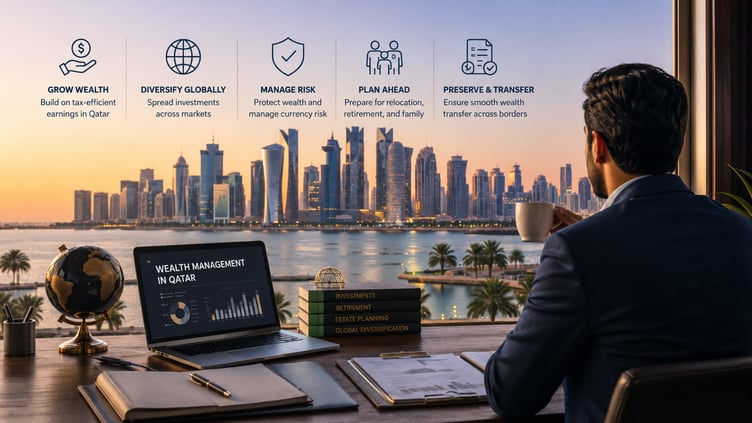
What Is Wealth Management for Expats in Qatar?
Wealth management in Qatar combines investment management with broader financial planning to help expats protect, grow, and transfer wealth efficiently across borders.
Depending on an individual's circumstances, wealth management may include:
- Investment portfolio management
- Retirement planning
- International tax planning
- Estate and succession planning
- Cash flow management
- Currency exposure management
- International banking coordination
- Insurance and risk management
For many globally mobile professionals, entrepreneurs, and executives in Qatar, wealth management focuses on preparing for life after Qatar as much as managing wealth while living there.
For example, an executive may earn tax-free employment income in Qatar while maintaining rental properties in the United Kingdom, investment accounts in Singapore, and retirement plans in Canada.
Rather than making isolated financial decisions, a wealth management strategy coordinates these assets so they continue working together regardless of future moves.
Investment consulting for expats: How does it fit into wealth management?
Investment consulting is one component of a broader wealth management strategy.
Investment consulting for expats focuses primarily on developing and managing an investment portfolio that aligns with an individual's objectives, risk tolerance, time horizon, and international circumstances.
Wealth management extends well beyond investments.
Investment consulting answers how assets should be invested, while wealth management also considers where wealth will eventually be used, how it will be transferred, and how financial decisions interact across different countries.
For instance, a family expecting to relocate from Qatar to Switzerland within five years may require a different investment strategy than someone planning to return permanently to India or the United Kingdom.
Investment consulting helps determine where and how assets should be invested, while wealth management ensures those investments support broader financial objectives.
What Is the Difference Between Offshore and Onshore Wealth Management?
The main difference between offshore wealth management and onshore wealth management is whether an expat's long-term investments are managed within Qatar or through an international financial center.
Onshore Wealth Management
Onshore wealth management may be appropriate for assets and financial activities connected to life in Qatar.
This may include:
- Managing Qatar-based salary and cash flow
- Investing in Qatar financial markets
- Holding short- to medium-term investments while residing in Qatar
- Maintaining local banking relationships for everyday financial needs
An onshore approach may work well for expats who expect to remain in Qatar for the foreseeable future or whose financial activities are primarily based in the country.
Offshore Wealth Management
Offshore wealth management is generally designed for assets that need to remain portable regardless of where an expat lives in the future.
This may be appropriate for:
- International investment portfolios
- Multi-currency wealth
- Retirement assets intended for use outside Qatar
- Investments held across multiple jurisdictions
- Long-term estate and succession planning
Because these arrangements are not tied solely to Qatar, they may provide greater continuity if an expat later relocates or retires in another country.
Which Approach Is Better for Expats in Qatar?
For many high-net-worth expats, the answer is both.
For example, an executive working in Qatar may keep local bank accounts and short-term cash reserves onshore while maintaining a globally diversified investment portfolio offshore.
This allows day-to-day finances to remain accessible in Qatar while preserving the flexibility to relocate without significantly restructuring long-term investments.
Is Financial Planning the Same as Wealth Management?
No. Financial planning and wealth management are closely related, but they are not the same.
Financial planning creates a roadmap for achieving financial goals.
Wealth management combines that roadmap with ongoing investment management, implementation, and continuous monitoring.
For expats in Qatar, financial planning typically addresses questions such as:
- When should retirement begin?
- Where will retirement take place?
- How much wealth is required?
- What income will be needed after leaving Qatar?
- How should future education costs be funded?
Wealth management then helps implement that plan by managing investments, adjusting portfolios as tax residency changes, coordinating international assets, and reviewing strategies as personal circumstances evolve.
For globally mobile expats, both services work together rather than replacing one another.
Building an Expat Financial Planning Strategy in Qatar
Effective expat financial planning begins with understanding that life in Qatar may only represent one stage of a much longer financial journey.
Define Long-Term Residency Plans
Future residency plans influence almost every financial decision.
Questions to consider include:
- Is Qatar expected to be a long-term home?
- Is retirement planned elsewhere?
- Will another international assignment follow?
- Is permanent residency or citizenship being pursued in another country?
The answers affect investment structures, liquidity requirements, retirement planning, and estate planning.
Review Global Assets and Liabilities
Many HNW expats accumulate wealth across several jurisdictions.
Examples include:
- Overseas property
- International brokerage accounts
- Company ownership
- Cash held in multiple currencies
- Pension schemes
- Trusts
- Family businesses
Reviewing these assets together provides a clearer picture of overall wealth rather than managing each separately.
Consider Future Tax Residency
Although Qatar does not impose personal income tax on employment income, future tax residency may significantly affect investment income, capital gains, pensions, and inheritance planning.
Planning ahead before relocating may reduce unnecessary restructuring later.
Build an International Investment Strategy
Rather than concentrating assets in one market, many globally mobile investors seek diversified exposure across multiple regions and asset classes.
Investment objectives should reflect:
- Future relocation plans
- Expected retirement location
- Currency requirements
- Income needs
- Risk tolerance
- Liquidity needs
Review the Strategy Regularly
International financial plans should be reviewed after major life events such as relocation, retirement planning, business exits, or changes in tax residency.
Best investment in Qatar for expats
The best investment options in Qatar for expats is typically a diversified portfolio that combines Qatar-based and international investments rather than relying on a single asset or market.
The appropriate mix depends on an individual's financial goals, risk tolerance, time horizon, future country of residence, and overall wealth management strategy.
Qatar Financial Markets
Some expats allocate a portion of their portfolios to large-cap companies listed on the Qatar Stock Exchange, particularly those in the banking, energy, telecommunications, and industrial sectors, to gain exposure to Qatar's economy while continuing to earn income in the country.
International Equities
Many HNW expats complement their Qatar holdings with globally diversified equity portfolios, often through international funds or ETFs that provide exposure to major markets such as the United States, Europe, and Asia, reducing reliance on a single economy.
Fixed Income and Sukuk
Investment-grade government and corporate bonds, along with sukuk, may provide more stable income and help reduce portfolio volatility, particularly for investors approaching retirement or seeking to preserve capital.
International Real Estate
Rather than purchasing additional property in Qatar, many expats invest in residential or commercial real estate in countries where they expect to retire, obtain residency, or maintain long-term family ties, helping align property ownership with future lifestyle and financial objectives.
Alternative Investments
For investors with substantial portfolios, private equity, private credit, infrastructure funds, and venture capital may provide additional diversification beyond traditional stocks and bonds, although these investments typically involve longer holding periods and lower liquidity.
How to Manage Risk in a Portfolio for Expats in Qatar?
Managing risk for expats in Qatar means reducing exposure to a single country, currency, or asset so a future relocation or change in tax residency does not significantly disrupt long-term financial goals.
Avoid Overexposure to Qatar
Many executives and business owners already have significant financial exposure to Qatar through their salary, employer, business interests, or property.
Investing too heavily in Qatar financial markets on top of these assets can further concentrate risk.
For many expats, a Qatar allocation is often only one component of a broader internationally diversified portfolio.
Diversify Assets Abroad
Holding investments across multiple countries can reduce reliance on a single economy and provide exposure to different growth opportunities.
Diversification should reflect where future liabilities will occur.
An expat expecting to retire in Europe may gradually increase euro-denominated assets, while someone returning to Asia may prioritize exposure aligned with future spending needs.
This approach can help preserve flexibility if an expat later relocates or retires outside Qatar.
Manage Currency Exposure
Many expats earn income in Qatari riyals but expect future expenses in currencies such as US dollars, euros, or pounds sterling after leaving Qatar.
Aligning part of an investment portfolio with the currency of future liabilities may reduce the impact of exchange-rate movements over time.
Maintain Sufficient Liquidity
Portfolios heavily concentrated in real estate or private businesses may become difficult to access when capital is needed quickly.
Maintaining liquid investments alongside long-term holdings provides greater flexibility to fund relocation costs, business opportunities, education expenses, or unexpected financial needs without selling illiquid assets.
Is It Worth Paying for Financial Advisory Services?
For many expats in Qatar, financial advisory services become more valuable as wealth becomes increasingly international rather than simply larger.
Professional advice may be worthwhile if an expat:
- Is preparing to leave Qatar within the next few years.
- Has accumulated significant wealth during their time in Qatar.
- Needs to coordinate investments before becoming tax resident elsewhere.
- Owns businesses or investment properties in different countries.
- Is planning retirement or passing wealth to family members living in another jurisdiction.
Rather than selecting individual investments, a financial adviser can help coordinate major financial decisions before relocation, retirement, or succession to reduce unnecessary restructuring and keep long-term objectives on track.
How Should Wealth Management Change After Leaving Qatar?
Leaving Qatar should prompt a review of an expat's entire wealth management strategy, as financial decisions that worked during Qatar residency may no longer be appropriate after relocating.
A change in country of residence can affect investment priorities, banking arrangements, tax obligations, and long-term financial objectives.
Review Tax Residency
Moving to another country may change how investment income, capital gains, dividends, pensions, and foreign assets are taxed.
Before becoming tax resident elsewhere, expats should review whether their existing portfolio remains tax-efficient under the new country's rules and whether any restructuring should be completed before the move.
Reassess Currency Allocation
Many expats build wealth while earning in Qatari riyals, but future expenses may be in euros, pounds sterling, US dollars, or another currency.
As relocation approaches, gradually increasing exposure to the currency of future retirement, property purchases, or education costs may help reduce long-term exchange-rate risk.
Evaluate Investment Structures
Some investment accounts, banking relationships, or wealth management arrangements established while living in Qatar may not remain equally practical after relocating.
Reviewing whether investment platforms can continue servicing clients in the new country, and whether accounts should be consolidated or transferred, can help avoid unnecessary disruption.
Update Long-Term Planning
A move abroad is an appropriate time to revisit retirement projections, estate planning documents, beneficiary designations, and succession arrangements.
Conclusion
For many expats in Qatar, the country serves as a place to build wealth rather than a permanent destination.
Although long-term residence is possible for some individuals, many globally mobile professionals ultimately relocate for career opportunities, retirement, or family reasons.
A wealth management strategy that anticipates those transitions can help preserve continuity as financial priorities evolve across different countries and life stages.
That long-term perspective is often what distinguishes wealth management from investment management alone.
FAQs
What is the difference between consulting and wealth management?
Investment consulting focuses primarily on developing and managing investment portfolios.
Wealth management is broader and may include investment management, expat financial planning, retirement planning, tax coordination, estate planning, and succession planning as part of a comprehensive financial strategy.
Can expats invest in the Qatar stock market?
Yes. Subject to applicable regulations and brokerage requirements, expats may invest in companies listed on the Qatar Stock Exchange.
Many internationally mobile investors combine local investments with global portfolios to maintain diversification rather than concentrating their assets in one market.
Which business is most profitable in Qatar?
For expats, sectors such as energy-related services, technology, healthcare, logistics, professional services, and selected real estate activities are generally considered among the strongest commercial opportunities.
That said, there is no single most profitable business in Qatar, as profitability depends on the industry, market demand, execution, and regulatory requirements.
Related Articles: