South Africans can retire in countries such as Portugal, Mauritius, Malta, Spain, Greece, Cyprus, Thailand and Malaysia, with several offering residence routes designed for retirees or financially independent individuals.
The easiest destination will be based on factors such as retirement income, age, healthcare needs, tax residency and the requirements of each country's residence program.
Key Takeaways
- A pension or passive income can provide the financial basis for retirement residence.
- South African pension rights generally remain after emigration, but the tax treatment can change.
- A foreign residence permit does not automatically end South African tax residency.
- The destination's tax treatment of foreign pension income can materially affect the cost of retiring abroad.
My contact details are hello@adamfayed.com and WhatsApp +44-7393-450-837 if you have any questions.
The information in this article is for general guidance only. It does not constitute financial, legal, or tax advice, and is not a recommendation or solicitation to invest. Some facts may have changed since the time of writing.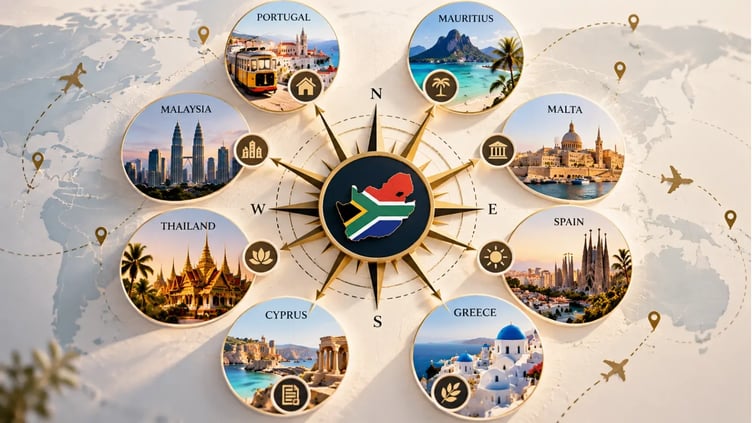
What makes a country easy for South Africans to retire in?
A country is relatively easy to retire in for South Africans when it offers a straightforward residence route, manageable financial requirements and practical conditions for long-term living.
For South African retirees, the main factors to consider are:
- Accessible residence pathways: Retirement or financially independent residence routes can simplify the move compared with employment-based immigration.
- Financial requirements: The required pension, passive income, savings or assets should be realistic relative to the retiree's finances.
- Healthcare access: Reliable and affordable healthcare becomes increasingly important during retirement, particularly where private insurance is required.
- Cost of living: Housing, healthcare and everyday expenses need to be sustainable on retirement income.
- Proximity to South Africa: Flight connections, travel time and access to family can make some destinations more practical than others.
- Long-term residence: Straightforward renewal requirements and the possibility of extending residence can make a country more suitable for permanent retirement.
Which country is the easiest for South Africans to retire to?
Portugal, Mauritius, Malta, Spain, Greece, Cyprus, Thailand and Malaysia are among the most accessible retirement destinations for South Africans, with each offering a different residence route and practical advantage.
The right option depends on whether the priority is proximity to South Africa, European residence, English language access, lower living costs or a specific retirement program.
Portugal — Passive Income Retirement Route
Portugal is one of the easier European countries for South Africans to retire in because its D7 Visa provides an established residence route for people with qualifying regular passive income.
This can be particularly relevant to South Africans receiving a pension, rental income or investment income, as the route is designed around financial self-sufficiency rather than local employment.
The country also has an established international community and a residence framework that can allow retirees to settle in Portugal while accessing the wider Schengen Area.
Mauritius — Close to South Africa
Mauritius is one of the easier retirement options for South Africans because it has a dedicated residence route for retired non-citizens and is geographically close to South Africa.
The dedicated retirement pathway means applicants do not need to rely on employment-based immigration, while the relatively short distance from South Africa makes the practical aspects of relocating and maintaining family connections simpler.
Malta — English-Speaking European Base
Malta can be one of the easier European retirement destinations for South Africans because it has a specific retirement program and English is an official language.
The Malta Retirement Program gives qualifying pensioners a residence route designed around retirement rather than employment.
The use of English can also reduce a common practical barrier when handling accommodation, healthcare and everyday administration after moving abroad.
Spain — Financially Self-Sufficient Residence
Spain is relatively accessible for South African retirees because its Non-Lucrative Visa provides a defined residence route for financially self-sufficient applicants who do not intend to work locally.
This makes the country particularly relevant to South Africans who can demonstrate sufficient pension, investment or other passive income.
The established nature of the residence route also means retirees can plan their move around a clearly defined immigration category.
Greece — Financially Independent Residence
Greece can be one of the easier European countries for financially independent South Africans to retire in because it offers a dedicated residence route for non-EU nationals with sufficient independent financial resources.
The Financially Independent Person route allows qualifying applicants to establish residence without relying on local employment.
This gives South African retirees with reliable independent income a defined pathway to European residence.
Cyprus — Permanent Residence Option
Cyprus can be relatively straightforward for South Africans seeking long-term retirement residence because qualifying financially independent applicants can apply for permanent residence under Regulation 6(2).
Unlike routes that are primarily based on short-term residence, this option can provide a more direct long-term residence framework for eligible applicants.
English is also widely used, which can simplify practical aspects of settling in the country.
Thailand — Dedicated Retirement Visa
Thailand is one of the easier Asian countries for South Africans to consider for retirement because it offers a dedicated retirement visa for eligible applicants aged 50 and over.
The Non-Immigrant O-A visa provides a defined route based on retirement rather than employment.
Thailand also has established expatriate communities and private healthcare facilities, giving retirees an existing infrastructure for settling abroad.
Malaysia — Long-Term MM2H Residence
Malaysia can be relatively accessible for South Africans seeking long-term retirement residence because the Malaysia My Second Home (MM2H) programme provides an established route for eligible foreigners without requiring local employment.
The program gives financially qualified applicants a framework for long-term residence, while Malaysia's widespread use of English and established international communities can make the practical transition easier for South Africans.
Comparing Retirement Options for South Africans
|
Country |
Residence route |
Main financial basis |
Key ease factor |
|
Portugal |
D7 Visa |
Regular passive income |
Established passive-income residence route |
|
Mauritius |
Retired Non-Citizen Residence Permit |
Retirement income / financial resources |
Close proximity to South Africa |
|
Malta |
Malta Retirement Program |
Pension income |
English-speaking and retirement-specific program |
|
Spain |
Non-Lucrative Visa |
Sufficient financial means |
Clear route for financially self-sufficient retirees |
|
Greece |
Financially Independent Person permit |
Independent income |
Residence route without local employment |
|
Cyprus |
Regulation 6(2) |
Financial independence |
Permanent residence option |
|
Thailand |
Non-Immigrant O-A |
Retirement income / savings |
Dedicated retirement visa for 50+ applicants |
|
Malaysia |
MM2H |
Financial resources |
Long-term residence without local employment |
South African pensioners: What visa or residency requirements matter most?
For South African pensioners, the most important residence requirements are proof of sufficient funds, minimum age, health insurance, accommodation and compliance with background and stay requirements.
Proof of Retirement Income or Financial Independence
The most important requirement is usually demonstrating that you can support yourself without working in the destination country.
Depending on the program, this may be shown through:
- Pension income
- Annuity income
- Investment income
- Rental income
- Savings or other assets
Some programs set a specific monthly or annual threshold, while others assess an applicant's overall financial position.
Minimum Age
Dedicated retirement visas often have a minimum age, commonly 50 or 55, while financially independent residence programs may have no specific retirement age requirement.
This distinction matters because a younger retiree may need to use a financially independent or passive income route rather than a program specifically intended for retirees.
Health Insurance
Health insurance is another important eligibility requirement, particularly in countries where retirees are not automatically covered by the public healthcare system.
Applicants may need to show valid private health insurance that meets the country's coverage requirements.
For older insurance applicants, the availability and cost of suitable coverage should also be considered before applying.
Proof of Accommodation
Some residence applications require evidence that the applicant has somewhere to live.
This may involve a rental agreement, property ownership documents or other accepted proof of accommodation.
Importantly, owning property is not universally required to obtain retirement residence.
Police Clearance and Supporting Documents
South African applicants may need to provide a police clearance certificate and supporting documents such as proof of income, bank statements, birth certificates, marriage certificates or medical documentation, depending on the destination.
Documents issued in South Africa may also need to be apostilled, legalized or translated before they can be accepted.
Renewal and Physical Presence
South African retirees should also check how long the permit remains valid, what is required for renewal and whether they must spend a minimum period in the country.
This is particularly important for retirees who intend to divide their time between their new country of residence and South Africa.
A residence permit may not necessarily be maintained simply because it was granted initially.
What happens to my pension if I emigrate from South Africa?
If you emigrate from South Africa, you can generally retain your South African pension or retirement savings, but what you can withdraw, transfer or continue receiving is based on the type of retirement fund and your tax residency status.
Emigration does not automatically cancel your pension or require the funds to be transferred overseas.
The rules differ between pension funds, provident funds, retirement annuities and other retirement products, so the treatment of each arrangement needs to be considered separately.
For retirees already receiving pension income, moving abroad generally does not mean that payments automatically stop.
However, where the pension is paid, how it is taxed and whether South African tax continues to apply can change after a change in tax residency.
How are South African pensions taxed when you retire abroad?
South African pension income can remain subject to South African tax after you retire abroad, but the outcome is determined by your South African tax residency, the tax rules of your new country and any applicable tax treaty.
Moving abroad does not automatically end South African tax residency.
If you cease to be South African tax resident and become tax resident in another country, the new country may tax your worldwide income, including pension income received from South Africa.
Double Taxation Agreements
A treaty may allocate taxing rights between South Africa and the country of residence, so retirees should check the specific agreement between South Africa and their chosen retirement destination.
South African Tax Residency
Your tax residency status is central to determining how your pension is treated after emigration. The date and circumstances of a change in tax residency can also matter.
South Africans with significant pensions, retirement funds, investments or property should assess their tax position before relocating.
Tax in the New Country
Some jurisdictions have specific provisions or preferential regimes for foreign retirees, while others generally include foreign pension income in taxable income.
A country with an accessible retirement visa may have a very different tax outcome from another destination once pension income is taken into account.
Conclusion
For South Africans, retiring abroad is not simply a matter of securing residence in another country; the financial consequences of the move can shape the sustainability of retirement for years to come.
The timing of the move can also matter, particularly where a change in tax residency affects pension income, retirement assets or other investments.
A well-planned retirement should therefore consider not only where to live, but also how the move will affect existing financial arrangements and future income.
FAQs
How many South Africans can retire comfortably?
Only around 6% of South Africans are estimated to be in a position to retire comfortably, with a commonly used benchmark being retirement income of about 75% of final salary.
The figure highlights why South Africans planning to retire abroad need to assess whether their pension and other retirement assets can support their intended lifestyle and the additional costs of living overseas.
Is it true that foreigners are leaving South Africa?
Yes, South Africa has experienced emigration, including departures driven by employment, family, investment, lifestyle and retirement considerations.
However, emigration trends alone do not establish whether retiring abroad is financially or practically better for an individual.
What triggers tax residency in South Africa?
An individual is generally a South African tax resident if South Africa is their ordinary home or they meet the physical presence test.
The physical presence test requires more than 91 days in the relevant tax year, more than 91 days in each of the previous five tax years, and more than 915 days across those five years.
Related Articles
- What is the cheapest and safest country to retire in?
- Best Expat Pension Plans
- Best Expat Podcasts for Pension Planning
- When Can You Afford to Retire as an Expat?
- How Do You Know If You Are Financially Ready to Retire?
- Expat Retirement Tax Planning: What to Check Before First Withdrawal
- Expat Pension Advice: Avoid Expat Retirement Pitfalls with Proper Guidance
- Top South African Expat Investment Options